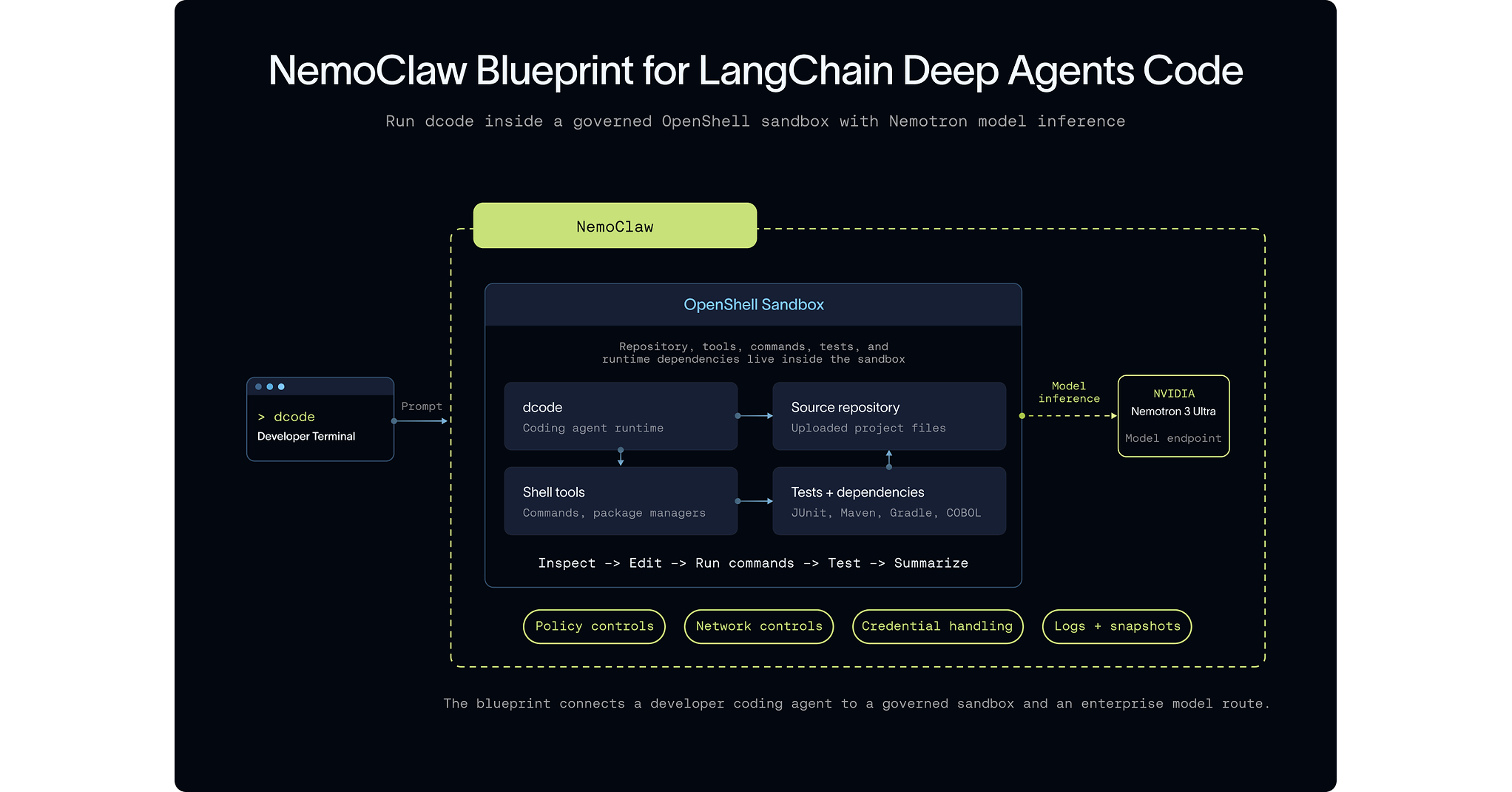
LangChain and NVIDIA launched the NemoClaw blueprint for building enterprise agents using Nemotron 3 Ultra plus the LangChain Deep Agents harness and NVIDIA OpenShell runtime. In LangChain’s evals, Nemotron 3 Ultra delivered an aggregate score of 0.86 at a cost of $4.48 versus $43.48 for the next closest model (~10x lower inference cost). The stack is positioned to enable secure, governed deployment and make it practical to run and evaluate more specialized agents at production scale.
The key mechanism is not cheaper AI, but cheaper iteration: when the cost of running agentic workflows falls by an order of magnitude, enterprises stop treating agents as demos and start wiring them into live workflows. That is structurally positive for NVIDIA because lower per-call cost tends to expand total token volume and GPU utilization faster than it compresses pricing; the market often misses that inference elasticity is the real driver. NBIS is a cleaner second-order beneficiary than a generic cloud name because the announcement reinforces demand for specialized AI-native hosting, but the monetization lag is likely months, not days, and will depend on whether these blueprints convert into committed production workloads.
Competitive dynamics shift toward the orchestration/runtime layer rather than model-only differentiation. That is mildly negative for closed-stack software vendors over 6-18 months because the value accrues to whoever controls deployment, tracing, and governance, while model performance becomes increasingly commoditized by open-weight alternatives. WDAY is not a direct read-through, but if enterprise agents become cheaper to deploy, it can eventually lift workflow automation attach rates; still, there is no evidence here that it changes near-term bookings or seat expansion.
The contrarian risk is that the market over-interprets a benchmark as proof of enterprise adoption. The score improvement may be harness-specific and not portable across real production environments with messy data, compliance constraints, and heterogeneous tools. The thesis is falsified if NVIDIA commentary on inference demand does not improve over the next 1-2 quarters, or if NBIS fails to show measurable capacity utilization / revenue conversion from these partnerships by the next reporting cycle.
AI-powered research, real-time alerts, and portfolio analytics for institutional investors.
Request DemoOverall Sentiment
strongly positive
Sentiment Score
0.45
Ticker Sentiment
