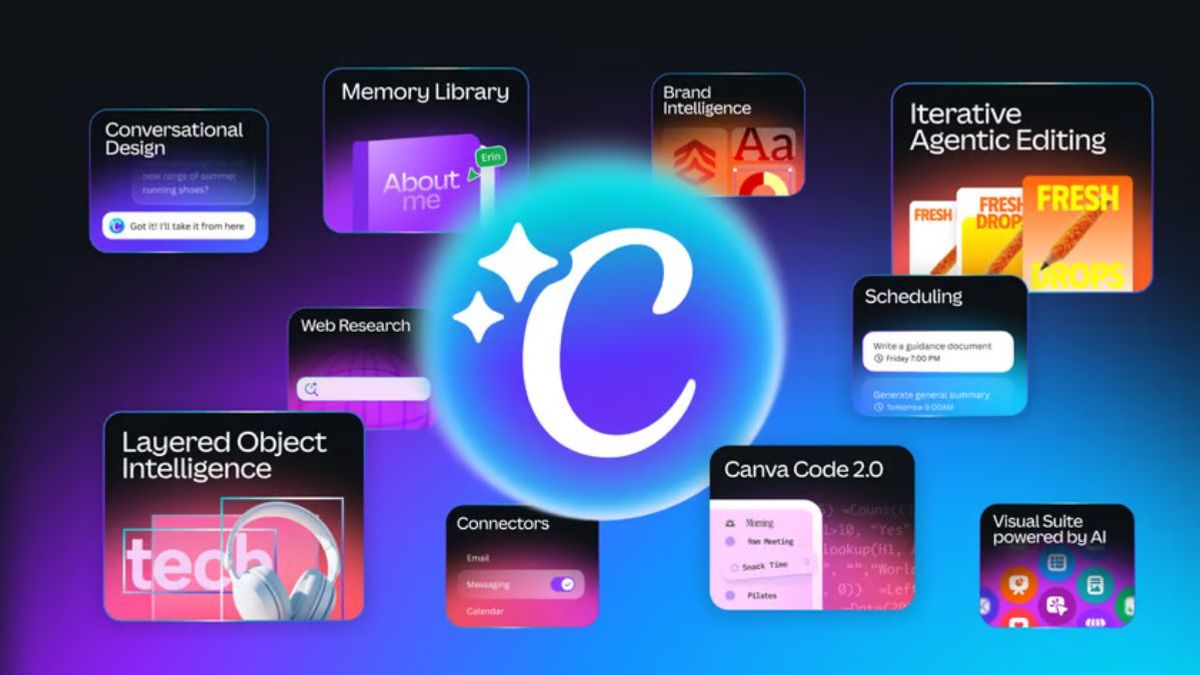
Canva announced Canva AI 2.0, its biggest product update since 2013, introducing conversational design, memory, agentic editing, layered object editing, and six new workflows including connectors, scheduling, web research, brand intelligence, Sheets AI, and Canva Code 2.0. The update moves the platform toward an end-to-end creative workflow that starts from prompts rather than templates. The feature is currently in research preview, making the near-term market impact notable but limited.
This is less a product launch than a bid to move up the software value chain from “design application” to “workflow operating system.” The strategic implication is that Canva is trying to reduce the surface area where Adobe, Figma, Microsoft, and point SaaS tools can monetize adjacent tasks, which matters because workflow capture usually expands ARPU more reliably than feature capture. If the memory and agentic layers work, the company can raise switching costs without needing customers to fully abandon incumbent tools on day one.
The second-order effect is on the ecosystem of lightweight productivity and creative tools that thrive on fragmentation. Anything that depends on users hopping across docs, sheets, slides, chat, and asset libraries is vulnerable if Canva can keep creation, revision, and distribution inside one loop; that is a demand risk for standalone collaboration and template-driven products more than for premium pro-grade suites. The biggest monetization lever is not feature differentiation but time saved per project, because that expands usage frequency and makes seat expansion easier to justify in both SMB and mid-market accounts.
The near-term risk is execution, not demand: research preview products often look transformative in demos but fail at reliability, permissions, brand consistency, and enterprise governance. Over the next 6-12 months, the key catalyst is whether Canva can convert experimentation into paid workflow adoption and measurable retention uplift; if not, the market will reclassify this as an engagement feature rather than a platform shift. Over 2-3 years, the real threat is incumbents copying the same conversation-first interface while retaining stronger enterprise control and distribution.
Contrarian view: the market may overestimate how quickly conversational AI replaces template-based creation for serious commercial work. In high-stakes use cases, users often want speed only up to the point where layout drift, hallucinated structure, or brand variance become costly, which caps how far autonomy can go before human review reasserts itself. That argues for a slower but more durable adoption curve, with the first winners being vendors that monetize workflow orchestration rather than pure generation.
AI-powered research, real-time alerts, and portfolio analytics for institutional investors.
Request TrialOverall Sentiment
moderately positive
Sentiment Score
0.42
