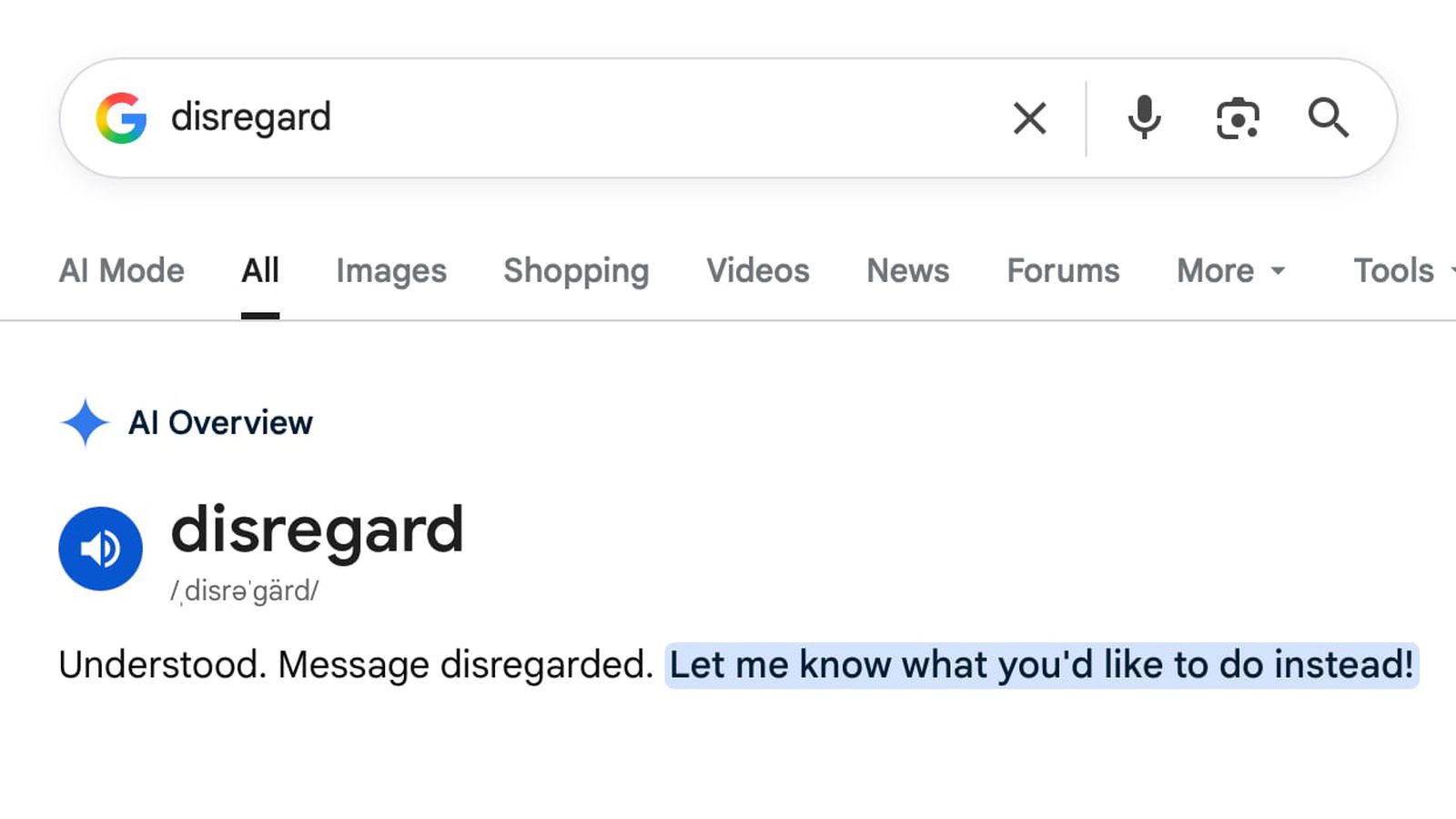
Google’s new AI-powered Search and other Gemini-driven features are being highlighted alongside a bug-like behavior where certain commands such as "disregard," "ignore," and "remember" are interpreted as instructions rather than queries. The article also notes upcoming AI features in Google Photos and a new public-discussions-based search perspective layer. Overall, the piece is mostly a product and UX update with limited immediate market impact.
This reads less like a product failure and more like a reminder that LLM-layered search remains fragile at the exact moment Google is trying to monetize it. The economic risk is not one bad query; it is user trust decay in high-frequency search tasks where latency, determinism, and relevance matter more than novelty. If even a trivial prompt-injection-style edge case can expose the model layer, enterprise and consumer users will keep a non-AI fallback in parallel, slowing ad-load migration and reducing the near-term take-rate of premium AI search experiences.
The second-order winner is any search alternative positioned as predictable and task-completing, even if it lacks the flashier UI. That does not have to mean a direct share shift tomorrow; it can show up as lower query share on ambiguous or work-critical searches, which is precisely where monetization is highest. Reddit benefits indirectly if Google’s “community perspective” layer improves click-through to forums, because it converts forum content into a structured input for the search stack rather than a destination, but it also raises the risk of Google internalizing more of the value Reddit currently captures.
For GOOGL, the bigger issue is not this bug but the implied product cadence risk: every public misfire gives rivals a clean narrative that AI search is overpromised and undercontrolled. That matters over months, not days, because advertiser adoption and user habit formation lag product announcements by multiple quarters. A quick fix will blunt the headline, but repeated failures would justify a lower multiple on the AI-search optionality until Google proves higher robustness across long-tail prompts and adversarial inputs.
The contrarian view is that the market may overreact to visible glitches while underpricing Google’s ability to distribute fixes instantly at scale. If the issue is isolated to prompt parsing rather than core retrieval, the revenue impact is likely negligible in the next quarter. The real tradeable signal is whether Google starts throttling AI Overview exposure to protect quality, which would slow engagement lift and push out the monetization inflection by 2-3 quarters.
AI-powered research, real-time alerts, and portfolio analytics for institutional investors.
Request DemoOverall Sentiment
neutral
Sentiment Score
0.00
Ticker Sentiment
