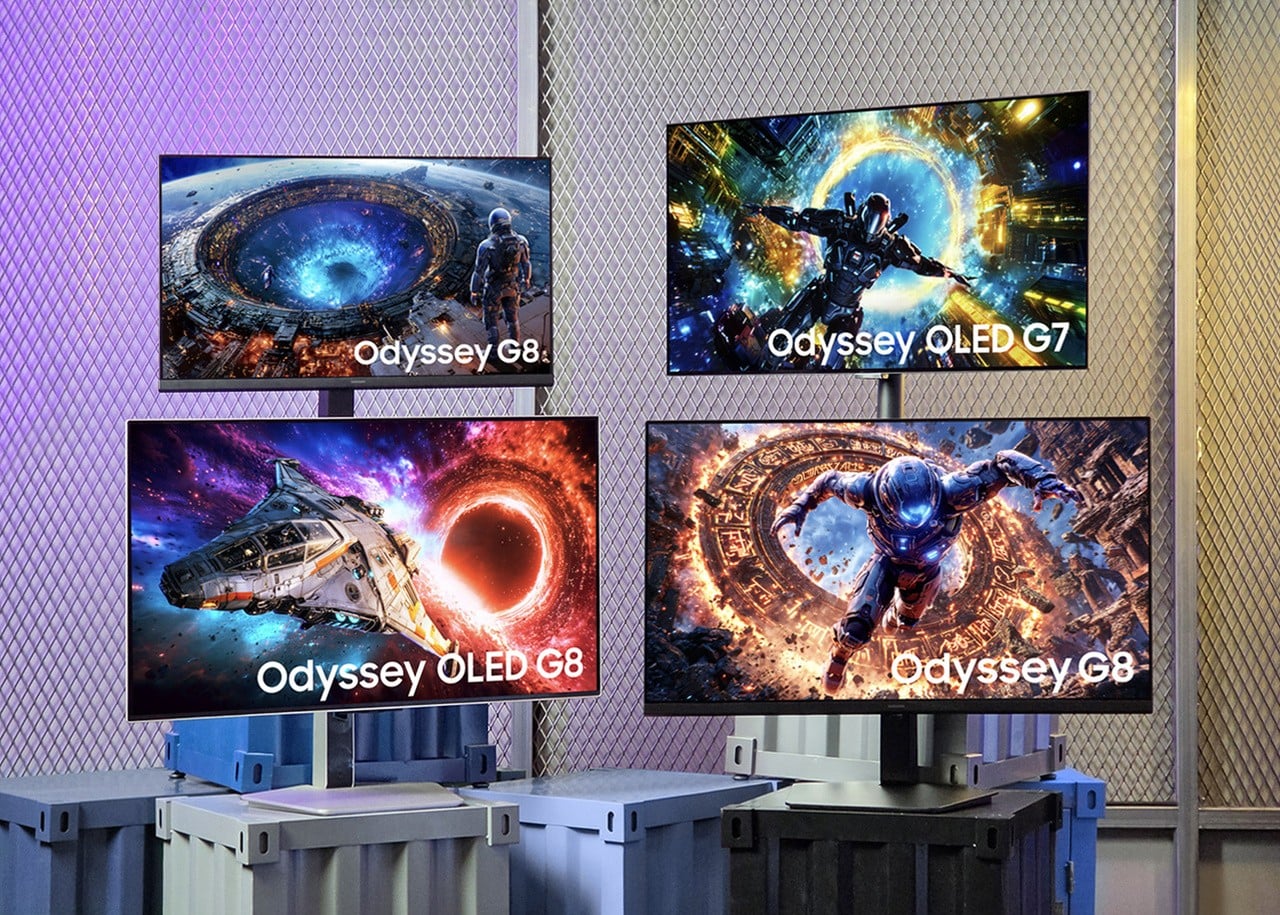
Samsung unveiled a new monitor lineup led by the first 6K gaming monitor, the Odyssey G8 G80HS, a 32-inch Fast IPS panel with a 6144x3456 resolution at 165Hz and dual-mode 3072x1728 at 330Hz. The broader announcement includes a 5K 180Hz IPS model, 4K 240Hz QD-OLED models in 27- and 32-inch sizes, and a 4K 165Hz W-OLED model with 1080p 330Hz dual mode, with UK-equivalent prices ranging from about £590 to £940. The products are already on sale in some regions, with OLED models due later this year.
This reads less like a one-off consumer launch and more like Samsung attempting to re-price the premium monitor market around resolution-as-a-feature rather than raw refresh rate. The second-order effect is a likely mix shift toward higher ASP panels, which helps panel suppliers and controller/component vendors even if unit growth stays modest; the biggest pressure is on competitors that have made OLED the only credible premium narrative, because Samsung is now offering an IPS path for buyers who want large-format productivity plus occasional gaming without burn-in anxiety.
The 6K and 5K SKUs matter most as halo products: they can pull demand through the channel even if volumes are tiny, and they may force rivals to respond with denser LCDs or price cuts on 4K240 OLED. A more interesting medium-term implication is that dual-mode functionality is becoming table stakes in enthusiast monitors, which commoditizes one of OLED’s advantages in gaming and shifts the buying decision toward brightness, longevity, and connectivity. That is slightly negative for pure-display differentiation, but positive for any firm with strong firmware, scaler, and panel calibration capabilities.
For the market, the near-term catalyst is not revenue impact but channel sentiment and pre-order behavior over the next 1-2 quarters. The tail risk is that these specs look better on paper than in consumer usage: at these sizes, buyers may decide that 4K240 is the sweet spot and treat 5K/6K as niche workstation products, limiting the halo effect. Conversely, if review benchmarks show acceptable text clarity and low-latency dual-mode performance, Samsung could reset the benchmark for premium monitor pricing and improve attach rates into higher-end laptops and GPU ecosystems.
AI-powered research, real-time alerts, and portfolio analytics for institutional investors.
Request DemoOverall Sentiment
mildly positive
Sentiment Score
0.35
Ticker Sentiment
