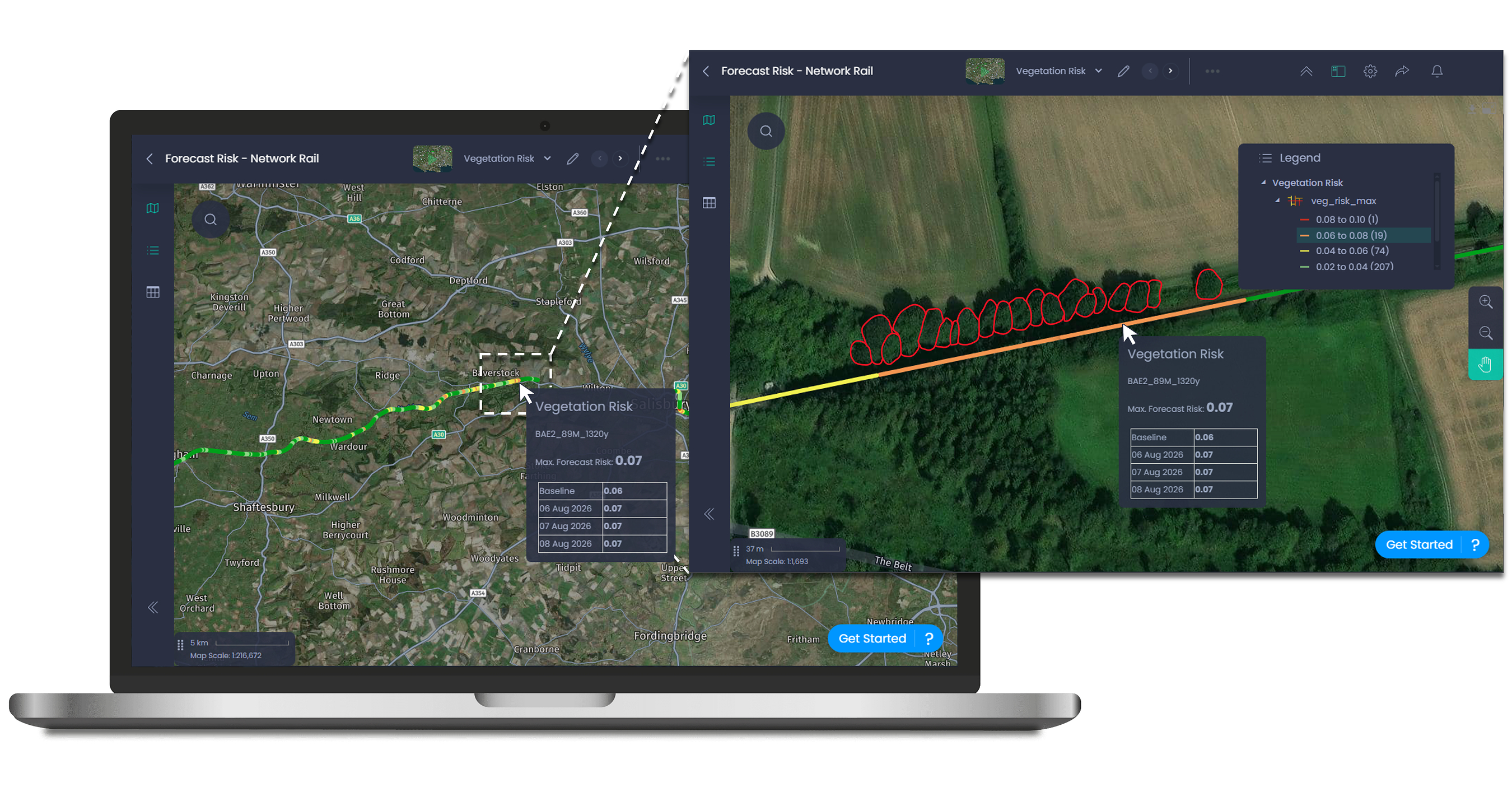
Network Rail and CATALYST completed a 12-week satellite-enabled exploratory pilot on the Wessex Route to identify flooding and vegetation risks up to 3 days in advance using Earth Observation (optical + InSAR) and short-range weather forecasting. The prototype generated location-specific risk forecasts across three hazard classes (ground deformation, vegetation fall-in, flooding) with daily updates via a traffic-light dashboard, and early feedback was “broadly consistent” with known risk areas. The initiative may support more frequent, evidence-based monitoring and more targeted inspections, subject to further development and validation.
The clean read-through is not a revenue event for Network Rail; it is a validation event for Earth-observation software as a workflow tool in asset-intensive, weather-exposed infrastructure. The near-term beneficiary set is the small-cap satellite analytics complex — PL, BKSY, SPIR — because this is the kind of pilot that can convert into multi-site procurement if it reduces false dispatches and inspection costs. The second-order winner could be geospatial data integrators and industrial software vendors like TRMB, while manual inspection and vegetation-management contractors face gradual pressure if remote scoring becomes the first-pass filter.
The market should distinguish pilot success from budget conversion. In rail and utilities, the sales cycle is usually 6-18 months, and adoption hinges on demonstrated reduction in disruption minutes, not just model accuracy; if the dashboard cannot show measurable improvement in response times or maintenance productivity, this stays a press-release story. The key falsifier is a lack of follow-on procurement, especially if Network Rail limits usage to a niche route rather than expanding to network-wide operations.
Contrarianly, the move may be underappreciated as a climate-adaptation use case rather than a satellite-imagery story. If this approach generalizes to roads, power lines, and water assets, the addressable market shifts from discretionary analytics spend to regulated resilience budgets, which supports higher long-duration multiples for the best-positioned EO vendors. But the consensus is likely overestimating immediacy: the first monetization benefit will be low-frequency, high-value public-sector contracts, not a broad demand inflection.
CPRX and RVSN do not appear to have direct economic linkage here, so forcing a trade in either would be low-conviction. The only actionable angle today is to treat this as a sector signal for small-cap geospatial names after any post-news weakness, while waiting for evidence of conversion into recurring contracts or network-wide rollout.
AI-powered research, real-time alerts, and portfolio analytics for institutional investors.
Request DemoOverall Sentiment
mildly positive
Sentiment Score
0.18
Ticker Sentiment
