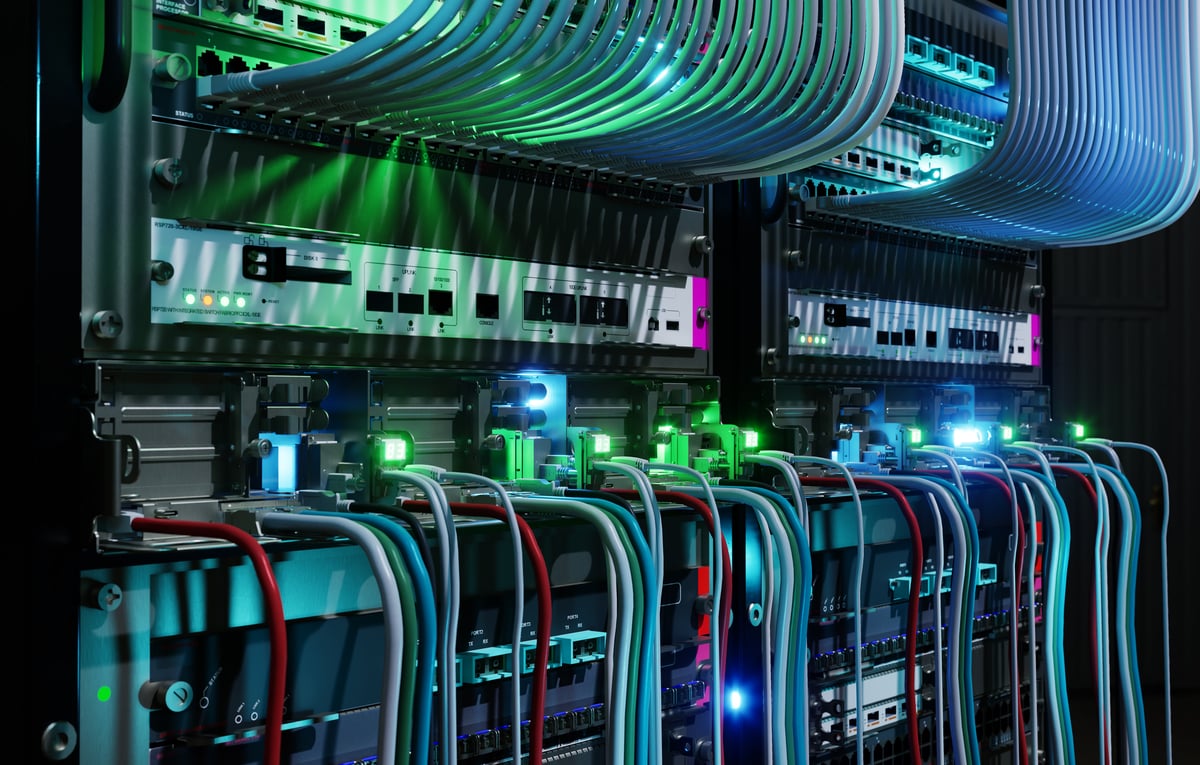
Vertiv Holdings, a supplier of power converters and server racks benefiting from AI-driven data-center demand, has produced outsized returns: 1-year +40.8% (after a Jan +20.8% and an April trough down 53.2%), 3-year +1,110%, and 5-year +822.3%, versus S&P 500 returns of 13.4% (1y), 68.3% (3y) and 86.7% (5y). The rally follows a severe early-2022 selloff triggered by Q4 2021 results that showed a $3.9m operating loss versus a $120m operating profit year earlier and a 95% drop in free cash flow (shares were down as much as 67% in 2022), highlighting that AI-driven demand and buying the dip have rewarded holders but increased volatility.
Market structure: Vertiv (VRT) is a direct beneficiary of hyperscaler AI capex — power distribution, racks, and cooling see front-loaded spend versus landlords and software vendors. Expect vendors with modular, high-efficiency gear to gain share; legacy heavies may face price pressure as customers prioritize TCO and deployment speed. Strong near-term demand (VRT up ~40% Y/Y, +1,110% 3yr) tightens lead times for copper/transformer-related inputs and lifts options IV; higher capex expectations can raise corporate borrowing and pressure long-duration bonds if sustained. Risk assessment: Key tails are a sharp hyperscaler pause (20–40% cut in planned AI spend), export controls to China limiting addressable market, or rapid margin collapse from aggressive discounting; any of these could halve VRT’s rally in 3–12 months. Near-term (days/weeks) watch order-book prints and IV spikes; medium-term (3–9 months) monitor quarterly bookings and gross-margin trends; long-term (12+ months) depends on AI adoption curve and supply-chain normalization. Hidden dependency: VRT’s growth is concentrated with a few customers — 20–30% revenue haircut if one hyperscaler slows. Trade implications: Tactical: establish a small long now and scale on confirmed pullbacks or upside catalysts (earnings/order backlog). Use 9–12 month call spreads to express convexity without outright delta; sell short dated puts to collect premium if comfortable owning. Rotate away from broad industrials (XLI) into AI-exposed hardware suppliers and select semiconductor-capital-equipment peers. Contrarian angles: The market assumes sustained hypergrowth — consensus may underprice a 30–50% mean reversion if AI spending normalizes or competition intensifies. Historical parallels (GPU-cycle suppliers) show fast inventory cycles can reverse earnings in 6–12 months; an unintended consequence of the rally is new entrants compressing ASPs and margins. A disciplined entry with defined pain points (bookings <0% yoy or margin contraction >300 bps) protects against that scenario.
AI-powered research, real-time alerts, and portfolio analytics for institutional investors.
Request DemoOverall Sentiment
moderately positive
Sentiment Score
0.60
Ticker Sentiment
