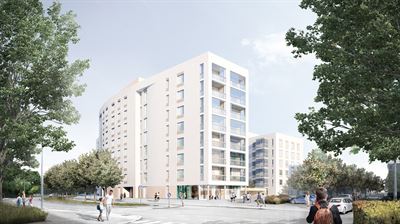
Skanska has signed a EUR 32M (approx. SEK 350M) contract with the City of Helsinki to build two residential buildings (six and eight stories) comprising 182 rental apartments (including 20 adapted for special needs) with ~11,900 sqm of floor area; construction is scheduled to start in Q4 2025 and complete by autumn 2027. The project targets a three‑star Rakennustieto environmental classification and the contract will be booked into Nordic order bookings for Q4 2025, representing a modest but positive backlog addition for Skanska's Finnish operations.
Market structure: The direct beneficiary is Skanska AB (STO: SKA-B/A) and its subcontractor/supplier ecosystem (concrete, timber, MEP firms) through a steady EUR 32M (SEK ~350M) municipal contract; competitors like YIT (HEL: YIT1V) and NCC (STO: NCC-B) face marginally higher competition for municipal tenders in Helsinki but no immediate price war. At the market level this is demand-affirming for municipal rental stock — 182 units adds ~11,900 m2, immaterial to city housing stock but signals continued public tender pipeline into 2026–27. Cross-asset effects are muted: negligible sovereign impact, but potential small upward pressure on Finnish municipal issuance and modest local construction-material commodity demand (cement, steel) for H2 2025–2027.
Risk assessment: Key tail risks include cost inflation/labor shortages causing >10% project overruns, stricter environmental/regulatory changes raising capex by 5–15%, and subcontractor insolvency creating completion delays; such outcomes would compress margins and impair cashflow over 2026–27. Time horizons: immediate (days) — no material price reaction; short-term (weeks–months) — sentiment lift for Nordic construction peers; long-term (quarters–years) — meaningful revenue/backlog contribution when booked in Q4 2025 and cashflow through 2027. Hidden dependency: access to green financing (lower funding costs by ~10–30 bps) and municipal budget health are critical.
Trade implications: Direct: establish a 1.5–2.0% long position in SKA-B sized vs NAV, target +15–25% over 9–12 months; stop-loss 10%. Pair: long SKA-B vs short YIT1V (ratio 1:0.8) for 6–12 months to capture tender-win quality spread; unwind if relative underperformance >15%. Options: buy a 12-month SKA-B call spread (buy ATM, sell +20% OTM) allocating 0.3–0.6% risk budget to cap premium while capturing Q4 2025 booking visibility. Rotate 2–4% into Nordic green-building suppliers (cement/insulation) and trim high-leverage small builders with net debt/EBITDA >3x.
Contrarian angles: Consensus likely underestimates the optionality from municipal pipelines and green-finance economics — repeated municipal wins could compound into a >1% annual revenue runway by 2026 if another 3–4 similar contracts are secured. Conversely, reaction could be overdone if investors misread size: EUR32M is <0.5% of Skanska’s annual revenue base and therefore not transformative short-term. Historical parallels (municipal social-housing tenders) show steady low-margin cashflows rather than high-margin growth, so favor balance-sheet-strong contractors able to absorb small overruns. Watch for unintended consequence: higher ESG targets may increase upfront capex and extend payback beyond current booking cycles, pressuring free cash flow in 2026–2028.
AI-powered research, real-time alerts, and portfolio analytics for institutional investors.
Request DemoOverall Sentiment
mildly positive
Sentiment Score
0.28
