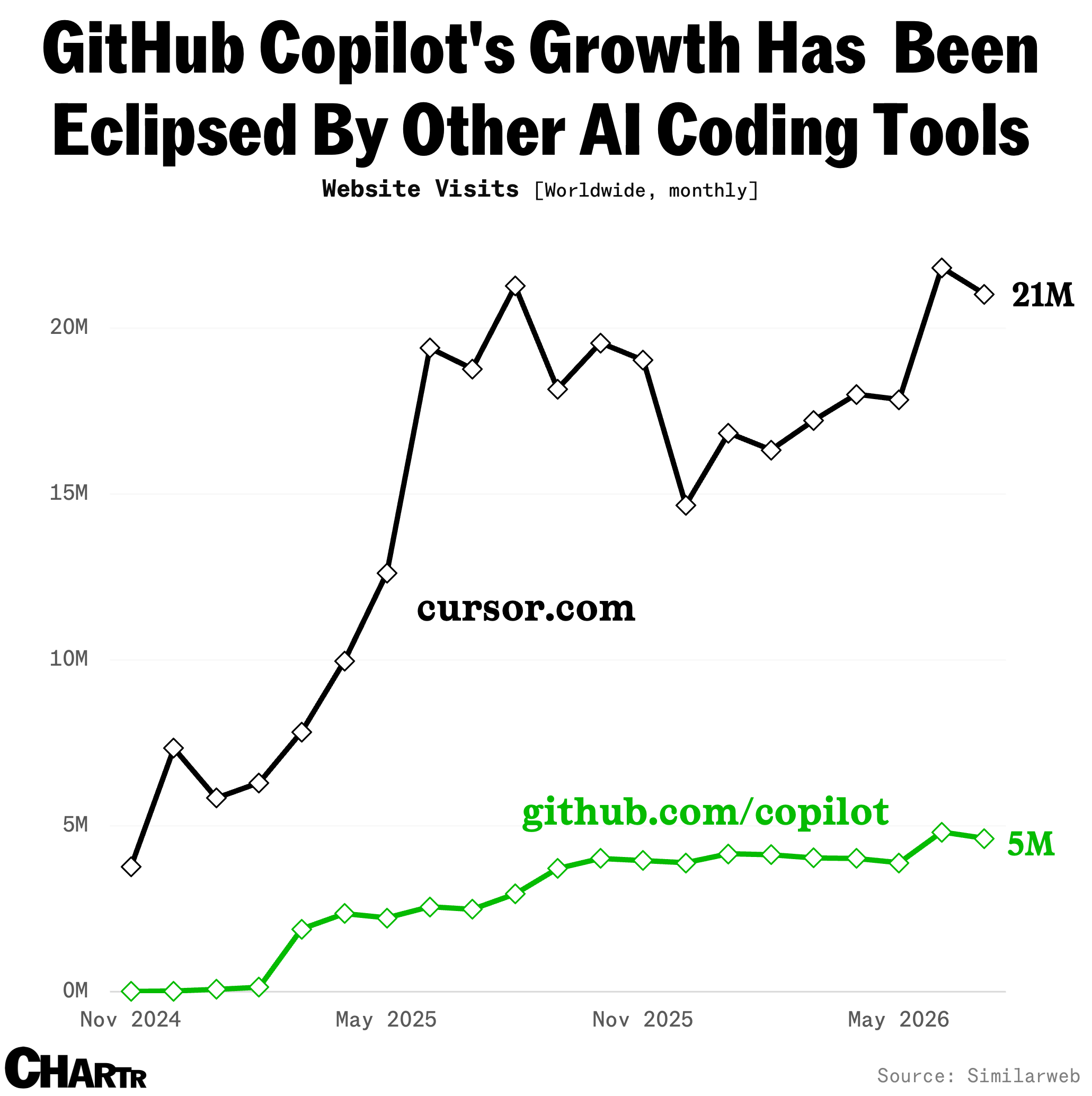
GitHub faces growing competitive pressure as Cursor and Claude Code erode Copilot’s first-mover advantage, with Microsoft management reportedly warning that rivals could eventually replace GitHub itself if it fails to adapt. The article also notes margin pressure from increased Copilot usage, repeated outages, and a breach of nearly 4,000 internal repositories after a malicious extension was installed. Microsoft is considering forcing engineers onto Copilot and shifting GitHub to a usage-based model to protect margins.
The key second-order issue is that GitHub’s moat is shifting from distribution to workflow lock-in, and that is a weaker moat in agentic coding. If the primary value creation moves from code hosting to code generation and orchestration, then the “default” product becomes whichever tool sits inside the editor with the highest perceived autonomy, not whichever platform stores the repository. That is structurally negative for MSFT because it risks turning GitHub into a utility layer while the economic rent migrates to the agent layer.
The margin pressure is more important than the headline user-growth story. Usage-based pricing may protect gross margin only if workloads are elastic; if the heaviest users are the most strategic ones, pricing them harder can accelerate churn to competitors with better latency or stronger developer mindshare. Over the next 6–12 months, watch for a classic product trap: raising effective price on power users while enterprise buyers increasingly demand multi-model flexibility, which compresses attach rates and reduces Copilot’s share of wallet.
Cybersecurity is an underappreciated catalyst for negative sentiment because it undermines trust in the platform at the exact moment Microsoft needs GitHub to be the safest place to build AI-native software. Even if the breach is operationally contained, it increases procurement friction for regulated customers and strengthens the case for self-hosted or competitor-led workflows. Over 12–24 months, that can matter more than immediate subscription churn because developer tooling decisions are sticky but reversible only when re-platforming pain is low.
The contrarian view is that the market may be overestimating near-term share loss and underestimating Microsoft’s ability to bundle, subsidize, and force adoption across the enterprise. If MSFT succeeds in converting internal engineering workflows to Copilot and packages GitHub as part of a broader security/compliance stack, it can preserve enterprise relevance even if consumer-facing buzz deteriorates. The risk/reward therefore favors bearish positioning on sentiment and margin compression, but not an outright thesis that GitHub becomes irrelevant quickly.
AI-powered research, real-time alerts, and portfolio analytics for institutional investors.
Request DemoOverall Sentiment
moderately negative
Sentiment Score
-0.45
Ticker Sentiment
