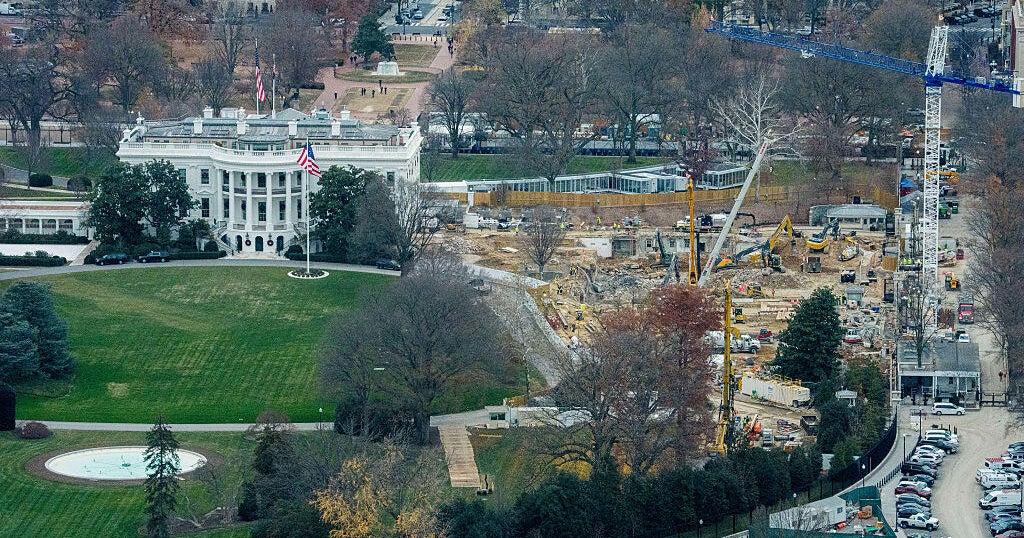
A federal judge allowed President Trump to continue demolition and construction work on a 90,000-square-foot White House ballroom after denying the National Trust for Historic Preservation's request for a preliminary halt, while ordering the administration to file plans with the National Capital Planning Commission and the Commission of Fine Arts by month-end. The National Park Service produced a previously unpublished environmental assessment completed in August; the $400 million project is privately financed and has not sought congressional approval, and the NCPC will hear a presentation Jan. 8 with a subsequent court hearing Jan. 15. The ruling reduces immediate legal obstruction but leaves regulatory and political uncertainty that could prompt further litigation or congressional scrutiny.
Market structure: Direct winners are large federal/architectural contractors and materials suppliers who gain optionality if executive prerogative short-circuits normal approval timelines; losers are preservation NGOs, boutique conservators, and D.C.-centric owners who rely on regulatory gatekeeping. Pricing power shift is small but asymmetric — a precedent for unilateral federal builds increases long-run bidding opportunity for well-capitalized contractors (firm backlog gains of +5–15% plausible over 12 months if approvals accelerate).
Risk assessment: Tail risks include a successful injunction or a Congressional statute curbing unilateral builds (low probability near-term, high impact on contractor forward revenue). Immediate catalysts are the NCPC presentation on Jan 8 and the court hearing on Jan 15 (days); expect elevated headlines/volatility around these dates, medium-term litigation noise for weeks, and a long-term precedent effect over 6–18 months. Hidden dependencies: private financing terms, contractor selection (prime vs. subcontracts), and reputational/legal costs could blunt upside.
Trade implications: Tactical opportunity set is small-capitalization exposure to federal construction cyclicality and short-term event volatility trades around Jan 8/15. Prefer selective longs in publicly traded federal contractors and materials names with 6–12 month time horizons and use option structures to monetize calendar volatility spikes; rotate small weight from politically sensitive REITs in the D.C. area into industrials/construction ETFs if conviction rises.
Contrarian angle: Markets will underprice the signaling effect — one high-profile unilateral project can shorten future procurement lead times materially; consensus is likely underweight the optionality premium for contractors. Counterparty risk and litigation costs are underappreciated: a protracted legal fight could suppress small-cap contractors and boost safe havens (TLT, GLD) temporarily.
AI-powered research, real-time alerts, and portfolio analytics for institutional investors.
Request DemoOverall Sentiment
mildly negative
Sentiment Score
-0.10
