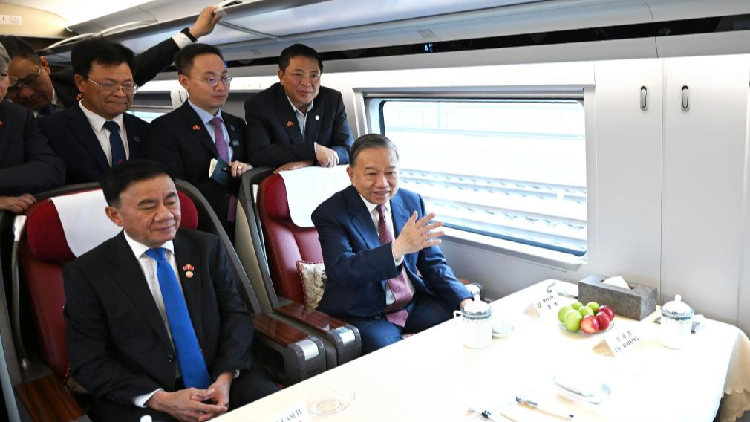
China highlighted the scale and performance of its high-speed rail network, with To Lam traveling more than 2,400 kilometers from Beijing to Guangxi in about 10 hours and praising the system's urbanization and technical capabilities. China said its HSR network has carried more than 22.9 billion passengers by end-2024 and is slated to reach 70,000 kilometers by 2035. The article also notes Vietnam has begun work on its first 120-kilometer high-speed railway, a $5.87 billion project targeted for completion in 2028.
This is less a “feel-good infrastructure story” than a signal that Beijing is exporting a political template: rail as a development instrument, not just transport capex. The second-order implication is that Southeast Asian governments will increasingly benchmark themselves against China’s execution speed, which raises the odds of policy acceleration for Vietnam’s broader corridor buildout, land acquisition reforms, and state-backed financing even if individual projects remain small. The immediate market read-through is for contractors, signaling equipment vendors, rolling stock suppliers, and financing intermediaries that can serve a multi-year pipeline rather than a one-off line.
The key competitive dynamic is that high-speed rail is a system sale, so the beneficiaries are not the obvious domestic operators but the industrial stack around them. In Vietnam, the first-order project is modest, but if it works politically it could unlock a larger north-south network and adjacent urban transit spending; that creates a multi-year import demand for signaling, electrification, track components, and power equipment. The loser set is air and long-haul coach operators on short-haul trunk routes, but the bigger hidden loser is underutilized secondary-city real estate and logistics nodes that currently depend on slow surface transport and may see traffic rerouted toward a few rail-connected hubs.
Risk is mostly execution, not demand. The 6-24 month window matters: land acquisition, financing, and integration with existing freight/passenger networks are the choke points that can turn a symbolic start into a delayed project, and any cost overrun would invite fiscal scrutiny because the initial investment is large relative to Vietnam’s capital market depth. A softer China-Vietnam relationship or a slowdown in Vietnam’s growth would also dampen the follow-on pipeline, while a successful opening phase would likely pull forward adjacent industrial parks and transit-oriented development by 1-3 years.
The contrarian angle is that the market may overestimate how directly China’s rail playbook transfers to Vietnam. A 350 km/h headline speed is less important than utilization, fare discipline, and network density; if the line is mainly a prestige corridor, returns will lag the hype and political enthusiasm can fade after the inauguration. That argues for trading the supplier ecosystem selectively rather than blanket bullishness on the entire EM infrastructure theme.
AI-powered research, real-time alerts, and portfolio analytics for institutional investors.
Request DemoOverall Sentiment
mildly positive
Sentiment Score
0.20
