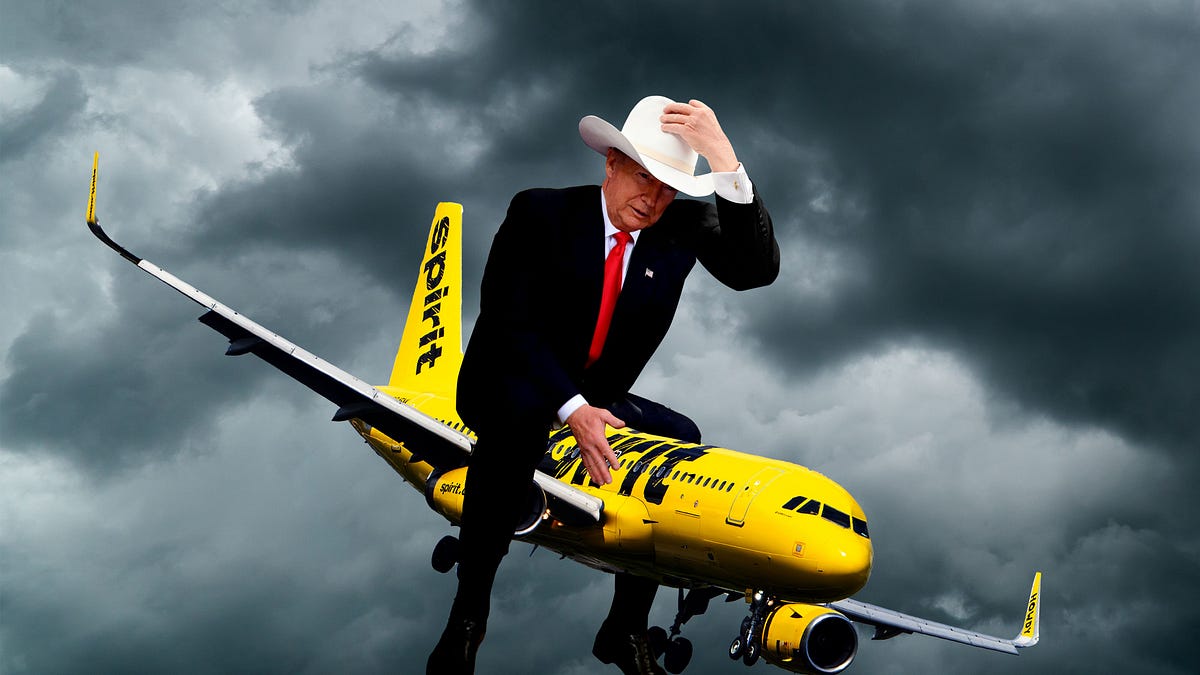
Spirit Airlines is facing possible liquidation after a second Chapter 11 filing in less than a year, with Trump-linked war-driven fuel costs adding an estimated $360 million to annual expenses. The administration is reportedly considering a $500 million taxpayer bailout or outright purchase in exchange for warrants that could give the government up to a 90% stake. The proposal highlights severe distress at Spirit and could move shares, but the broader market impact is limited.
This is less about one airline and more about the market pricing a new layer of political optionality into distressed transport assets. If the government becomes an equity-like backstop, it compresses bankruptcy risk for the sector but raises the expected dilution tax for existing holders across every carrier that might later be deemed “too visible to fail.” The second-order effect is that creditors and lessors may tighten terms preemptively, because a rescue regime lowers their recovery confidence and shifts downside to taxpayers rather than capital providers.
The biggest near-term winners are likely competing airlines with cleaner balance sheets and better pricing power, not the target itself. A failed low-cost operator’s capacity doesn’t disappear overnight; it migrates to stronger carriers through route consolidation, fare discipline, and better slot utilization over the next 3-12 months. If fuel remains elevated, ultra-low-cost models become structurally less viable, which should support margin expansion for incumbents with loyalty revenue and premium cabins.
The market’s mistake would be treating this as a purely ideological headline. The real catalyst is whether policymakers actually inject capital versus allow liquidation, because the path dependency matters: an announced rescue can stabilize supplier and lessor expectations within days, but a drawn-out process still forces aircraft groundings and route cuts over quarters. A reversal in crude or a public pushback on using taxpayer money would quickly reprice the probability of bail-out premium, but not the underlying fragility of low-fare pricing power.
Contrarian view: the trade may be underwhelming if investors assume a straightforward rescue. If the government takes a dominant equity stake, legacy shareholders and unsecured creditors could be close to wiped, while any upside is capped by political constraints on pricing and asset sales. That makes the situation more attractive as a relative-value short on weak balance-sheet carriers than as a directional bet on the distressed name itself.
AI-powered research, real-time alerts, and portfolio analytics for institutional investors.
Request TrialOverall Sentiment
strongly negative
Sentiment Score
-0.80
