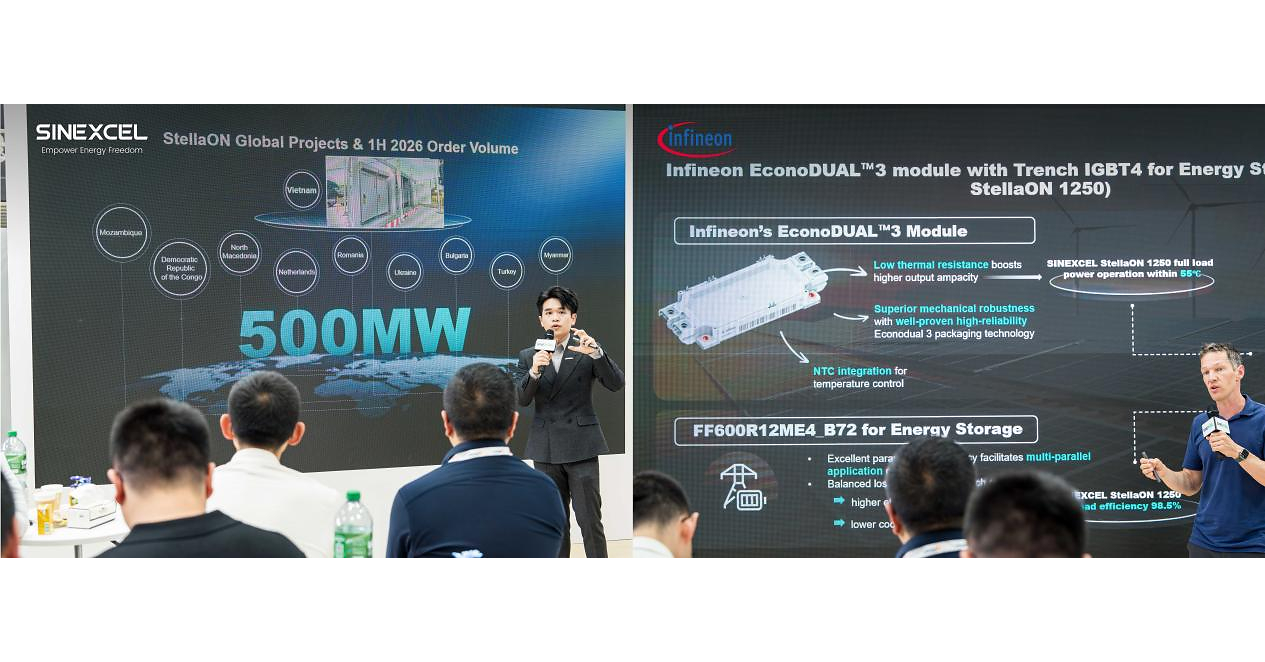
SINEXCEL launched the StellaON 1250K/1575K PCS for utility-scale energy storage at Intersolar Europe, targeting higher lifecycle economics via Infineon EconoDUAL™3 modules that reduce power derating by 15%–20% (55°C continuous output) and cut oversizing costs by up to 20%. The system claims 98.5% max full-load efficiency, a 0.6% round-trip efficiency gain, IP65/C5 corrosion protection, 300,000+ hour MTBF, and self-cleaning O&M design lowering lifetime OpEx by 15%. Company updates cite 500MW+ orders in 1H 2026 and 15+ projects under deployment, supporting a modest positive read-through for European grid-stability products.
This is more important as a signal for power-semiconductor attach rates than as a direct revenue event. If Europe’s storage market keeps shifting toward grid-forming, high-temperature systems, the incremental value accrues to the vendors inside the conversion stack that can prove reliability and certification, which structurally favors IFNNY over lower-spec component suppliers. The second-order loser is the commoditized PCS box-maker: differentiated thermal performance and black-start functionality make the module bill of materials harder to race to the bottom, but they also raise the bar for smaller competitors that lack global certification depth.
Near term, the market will likely over-interpret the launch as a demand indicator, but the financial impact is gated by project timing, content share, and pricing. The relevant catalyst path is 1-3 quarters, not days: watch whether IFNNY starts referencing power-module backlog, mix uplift, or margin support in industrial/power electronics. If Europe’s storage pipeline slows because of rates, interconnection delays, or soft ancillary-service pricing, this turns into a design-win story with little P&L translation.
Contrarian view: the consensus may be too bullish on “grid-forming” as a blanket growth driver. Standardization can expand the market, but it can also compress ASPs once OEMs converge on a common architecture, so the real winner is the vendor with the lowest installed-cost per MW, not the one with the flashiest launch. For IFNNY, the thesis is falsified if power-semi gross margin does not improve over the next 2-3 quarters or if European storage order flow fails to convert into measurable industrial revenue by year-end.
AI-powered research, real-time alerts, and portfolio analytics for institutional investors.
Request DemoOverall Sentiment
mildly positive
Sentiment Score
0.25
Ticker Sentiment
