
Europe's powerful Ariane 6 rocket launching 32 Amazon internet satellites this morning: Watch it live
Source: Space
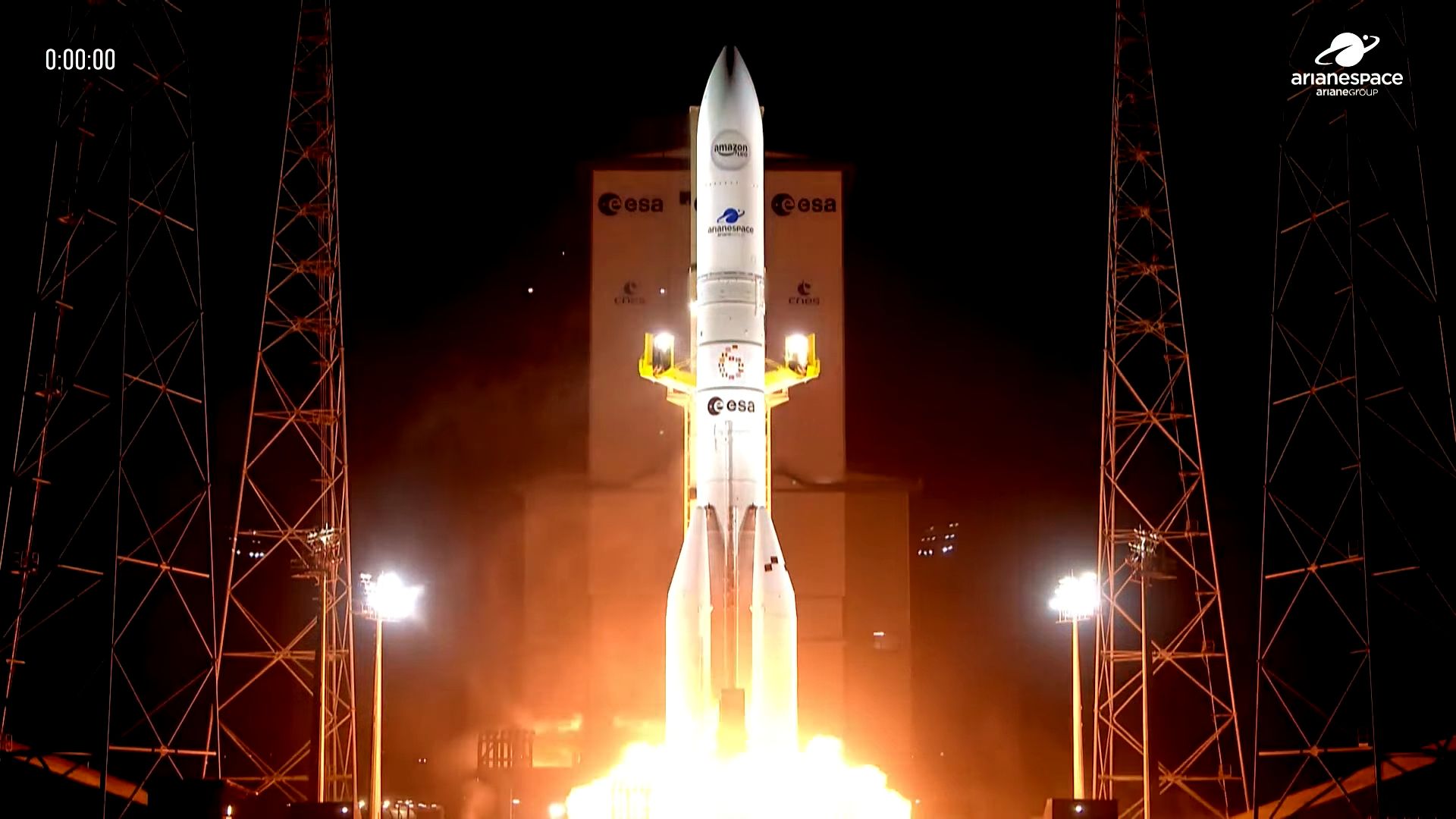
Ariane 6 launched 32 Amazon Leo satellites from Kourou in its seventh flight and the second launch of the Ariane 64 variant. Amazon has booked 18 Ariane 6 flights for its satellite constellation buildout, which will eventually total about 3,200 satellites. The article is primarily a launch update with limited near-term market-moving implications.
Analysis
AMZN’s satellite buildout is less about near-term revenue and more about de-risking a strategic moat: captive connectivity for its cloud, logistics, and device ecosystems. The marginal value is highest in regions where terrestrial backhaul is expensive or unreliable, so the real second-order upside is not just consumer broadband but enterprise, government, and maritime/aviation connectivity tied to AWS and fulfillment density. If execution stays on schedule, the network becomes a distribution layer that can lower customer acquisition costs across multiple Amazon businesses while creating a harder-to-replicate bundle than Starlink’s pure-play connectivity thesis.
The more important competitive dynamic is capacity discipline in launch services. Amazon’s multi-provider sourcing reduces dependence on any single rocket supplier, which compresses pricing power over time for launch incumbents and makes launch reliability the key differentiator rather than brand. That said, Ariane 6’s role is strategically valuable for Europe: consistent mission cadence would strengthen sovereign launch relevance, but a string of successful flights is needed before it can convert this into durable commercial share.
The risk/catalyst setup is asymmetric over months, not days. The immediate catalyst is execution cadence: each successful batch launch lowers perceived constellation risk and can support incremental multiple expansion for AMZN, but any mishap would hit sentiment because the market has already priced in Amazon’s long-duration optionality. Over 1-3 years, the key question is monetization: if ARPU on rural and enterprise customers lags capex intensity, the constellation becomes an expensive strategic adjunct rather than a profit engine; if it bundles with AWS edge services, the payoff could be meaningfully larger than the market currently discounts.
Contrarian view: the consensus may be underestimating how much this reinforces Amazon’s infrastructure advantage versus viewing it as a vanity project. The real equity value is in the option to subsidize connectivity through the balance sheet until it becomes a distribution moat for higher-margin services. The market may also be over-focusing on head-to-head consumer competition with Starlink; the more investable angle is Amazon turning connectivity into an enabling layer for logistics, cloud, and defense-adjacent contracts.
AllMind Terminal
AI-powered research, real-time alerts, and portfolio analytics for institutional investors.
Request TrialMarket Sentiment
Overall Sentiment
neutral
Sentiment Score
0.10
Ticker Sentiment
Key Decisions for Investors
- Maintain a tactical long bias in AMZN over the next 3-6 months; use any launch-related pullbacks to add, since successful constellation cadence supports a gradual rerating of Amazon’s optionality. Risk/reward: upside is multiple expansion from strategic moats; downside is limited to sentiment unless execution slips materially.
- Pair trade: long AMZN / short a basket of pure-play launch/service beneficiaries with weaker backlog quality, to express the view that Amazon’s internal demand reduces external launch pricing power over time. Time horizon: 6-12 months; thesis works if launch cadence stays smooth and pricing competition intensifies.
- For higher-risk expression, buy AMZN 12-18 month call spreads into launch cadence windows. This captures the market’s tendency to reward visible execution while capping premium outlay; risk is low if launches remain routine, but sharp downside if there is a constellation setback.
- Watch LMT and defense-adjacent comms names for second-order beneficiary flow if Amazon positions the network for government/secure connectivity use cases; a small exploratory long can work as a hedge against launch-cost inflation and sovereign-network demand. Time horizon: 1-2 years.
More News
- Nvidia CEO Jensen Huang emerges as Trump's top ally in AI safety debate
- It’s Donald Trump Versus MAGA on Data Centers
- Will worries about AI Doom end the AI Boom? BCA answers
- Prediction: Anthropic's IPO Will Be a Big Winner for Alphabet and Amazon Investors
- Generac: The $8 Billion Headline Is Wrong -- I'm Buying Anyway
- 3 AI Stocks to Buy Before the Next Fed Rate Decision
From AllMind Research
- Anthropic IPO Preview: Valuation, Timing, and What to Watch
- Shein After the IPO: Venue, Valuation, and What Must Be Proved
- What AI Research Tools Should a Small Hedge Fund Buy First?
- What a Concept From Nature Tells Us About How C-Suite Executives Actually Think About AI
- How to Track Earnings Call Sentiment Across Companies