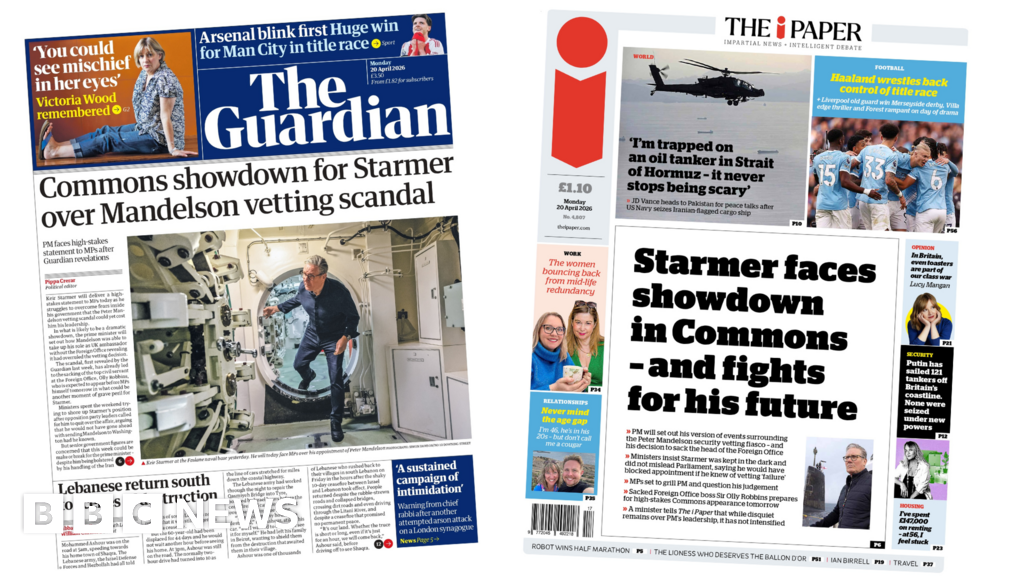
Prime Minister Sir Keir Starmer faces escalating pressure over the Lord Mandelson vetting scandal, with multiple papers framing Monday's statement as a leadership-defining test. The fallout also touches Whitehall governance, as the former top Foreign Office civil servant reportedly seeks legal advice after being removed. Separately, the article highlights ongoing geopolitical risk from the Israel-Lebanon ceasefire and US-Iran negotiations, but the piece is primarily a political news round-up rather than market-moving hard data.
The market implication is less about the individual scandal and more about whether this becomes a credibility event that forces a reset in cabinet discipline. In UK asset terms, the near-term winner is likely the opposition and any positioning that benefits from a higher probability of policy paralysis: gilts may find support if investors start pricing weaker reform velocity and a more defensive fiscal stance, while sterling could underperform on the margin if this widens the gap between rhetoric and execution. The first-order move should be in political risk premia, but the second-order effect is on the government's ability to push through anything requiring tight party management over the next 1-3 months.
The more interesting second-order trade is in defense and infrastructure sentiment. A government consumed by internal damage control tends to delay procurement decisions, bridge/transport remediation, and energy security commitments, which creates execution risk for UK contractors and lower-conviction domestic capex names. That matters most for projects already in the queue: if cabinet bandwidth gets absorbed now, award timing can slip a quarter or two even if budgets are eventually preserved.
On geopolitics, the Iran negotiation headline is a classic volatility suppressant only until it isn’t. A deal headline would compress energy volatility and support risk assets for days, but the threat architecture around strike escalation keeps the tail fat over 1-6 weeks; if talks fail, crude upside would likely be driven less by barrels lost immediately and more by a higher geopolitical risk premium, which bleeds into shipping, airlines, and industrial input costs. The contrarian view is that the domestic scandal may be over-absorbed in headline terms but under-absorbed in governance terms: the real damage is not resignation risk, it is reduced decision throughput at a moment when the administration needs policy velocity to regain control of the narrative.
AI-powered research, real-time alerts, and portfolio analytics for institutional investors.
Request TrialOverall Sentiment
mildly negative
Sentiment Score
-0.35
