
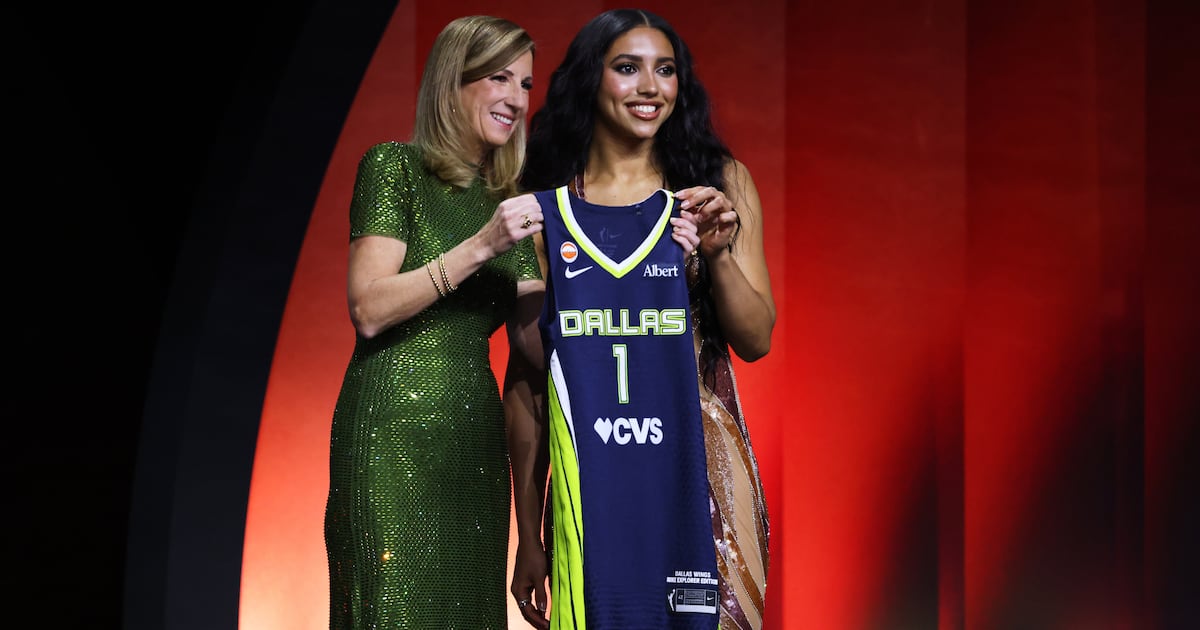
The WNBA draft delivered a record-setting class, led by Azzi Fudd going No. 1 overall to Dallas with a $500,000 rookie payday and UCLA producing a record six draftees. The new CBA materially boosts rookie compensation, with the No. 2 and No. 3 picks at $466,913 and $436,016, and second- and third-round salaries at $270,000. The article is largely celebratory and records several league milestones, including increased international participation and the first mother-daughter draft pair in WNBA history.
The immediate winner is the league’s labor platform, not any single team: the new CBA materially raises the floor for rookie compensation, which should improve talent retention and compress the historical gap between “star prospects” and veterans on cheap deals. That is bullish for competitive parity and for media inventory quality over the next 12-24 months, because higher-skill rookies are now less likely to be pushed overseas or out of the sport by economics. The more subtle effect is that the WNBA is increasingly pricing like a growth asset rather than a niche sports property, which should support future franchise valuations and sponsorship renewals.
The college-to-pro pipeline is also becoming more concentrated and more brandable. UConn and UCLA are functioning as talent monopolies, and that matters because the league’s next wave of audience growth is likely to come from recognizable collegiate brands converting directly into pro fanbases. That is positive for distribution partners and team-localized demand, but it also raises execution risk: if these stars don’t translate quickly, the valuation uplift embedded in expansion and rights optimism could fade over a 1-2 season horizon.
International participation is the other second-order signal. More non-U.S. talent widens the league’s addressable market and gives broadcasters more reasons to treat WNBA content as global, not domestic-only. But it also increases the odds that roster churn and travel load become a hidden cost pressure point, especially if the league expands international games before the core fanbase is fully monetized.
For the one ticker in scope, SUN looks structurally unchanged in the very near term, but the broader WNBA growth narrative is mildly constructive for sentiment around league-linked media assets and local-market exposure. The overdone consensus risk is assuming star-driven attention automatically converts into durable revenue; conversion still depends on scheduling, distribution, and whether the new pay structure keeps the best players in-market during the season rather than fragmented across other leagues.
AI-powered research, real-time alerts, and portfolio analytics for institutional investors.
Request TrialOverall Sentiment
mildly positive
Sentiment Score
0.20
Ticker Sentiment
