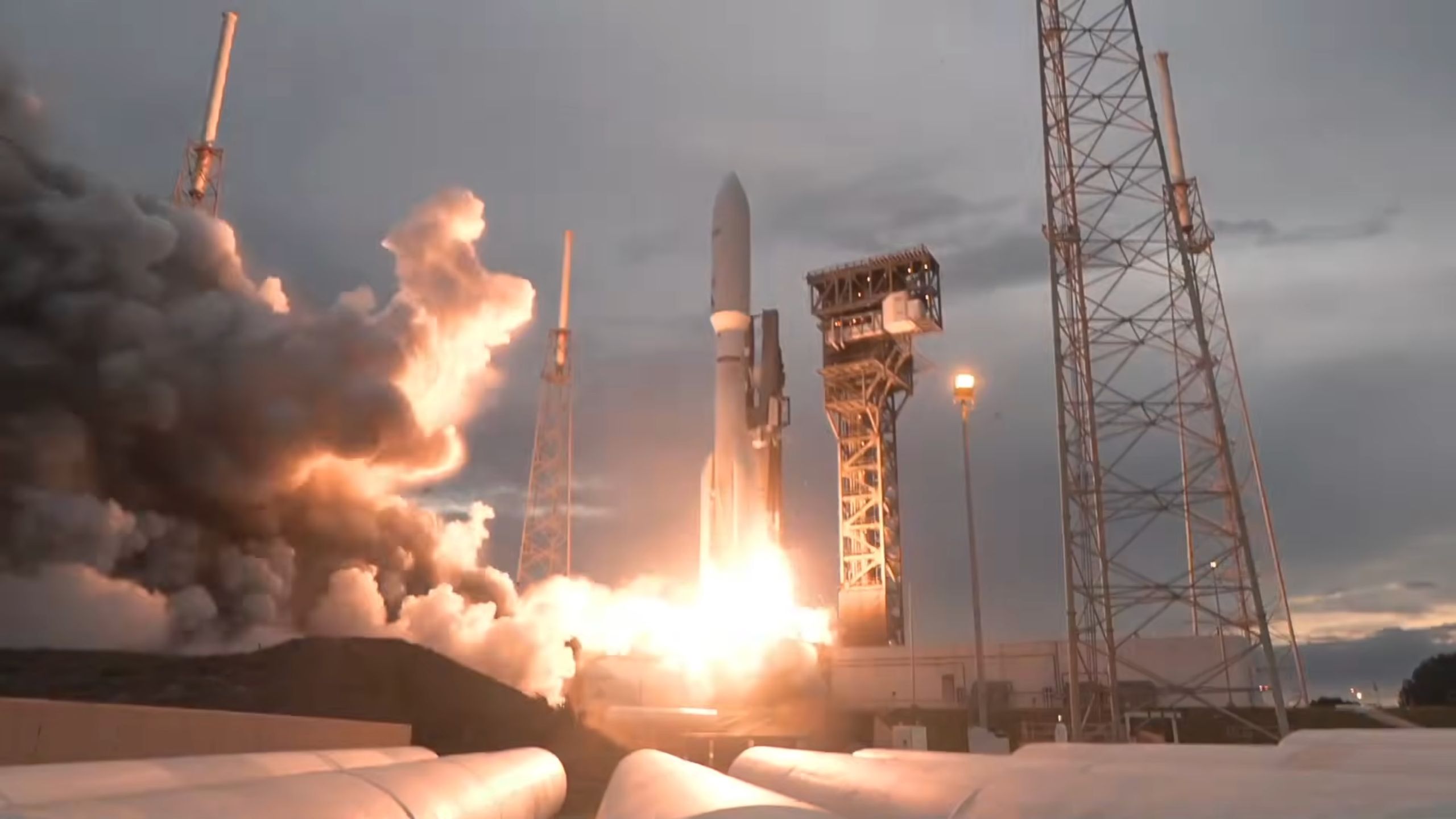
ULA’s Atlas V 551 successfully launched 29 Amazon Leo satellites, bringing Amazon’s in-orbit network to 329 spacecraft and tying the rocket’s heaviest payload record at about 18 tons. The mission was Amazon Leo’s 12th overall and its fourth this year, while Amazon still plans a much larger constellation of about 3,200 satellites requiring more than 80 launches. The article is mostly operational progress, though Blue Origin’s New Glenn setback could delay future launch capacity.
AMZN is quietly turning satellite broadband into an execution-and-capital-allocation story rather than a pure technology story. The near-term equity read-through is not from one launch, but from the increasing cadence of deployments: that matters because constellation businesses are won by time-to-scale, and every successful batch reduces the financing and customer-acquisition discount the market applies to the network. The market should also view the manufacturing/launch pipeline as the real bottleneck; once hardware is built, incremental launches are a signal that Amazon can convert capex into an addressable serviceable footprint faster than bears expect.
The failed Blue Origin test is the key second-order risk. It doesn’t just create schedule slippage for one rocket; it raises the probability that Amazon becomes more dependent on third-party launch cadence and less able to optimize unit economics through its own ecosystem. That can push the constellation’s breakeven further out by quarters, not weeks, if it forces re-routing of payloads to higher-cost or capacity-constrained providers. In the near term, this is more relevant for launch-service vendors and industrial suppliers than for AMZN’s retail core, but it can still affect investor confidence in the strategic optionality embedded in Amazon’s satellite stack.
Consensus may be underestimating how much of this is about future ARPU, not satellite count. The market often treats broadband constellations as a race to raw scale, but the differentiated ground infrastructure could allow Amazon to monetize with fewer spacecraft and potentially better margins if it can target enterprise, aviation, and remote connectivity first. The contrarian risk is that Starlink’s lead becomes self-reinforcing: customer penetration, terminal ecosystem, and operating data could make Amazon’s later-mover advantage irrelevant unless it finds a niche distribution angle.
For AMZN, the near-term stock impact is modest, but the strategic value is real if launch cadence stays intact over the next 6-12 months. The bigger trade is that launch delays or setbacks create a window where the market may discount Amazon’s space initiative more heavily than the long-duration option value justifies.
AI-powered research, real-time alerts, and portfolio analytics for institutional investors.
Request DemoOverall Sentiment
neutral
Sentiment Score
0.12
Ticker Sentiment
