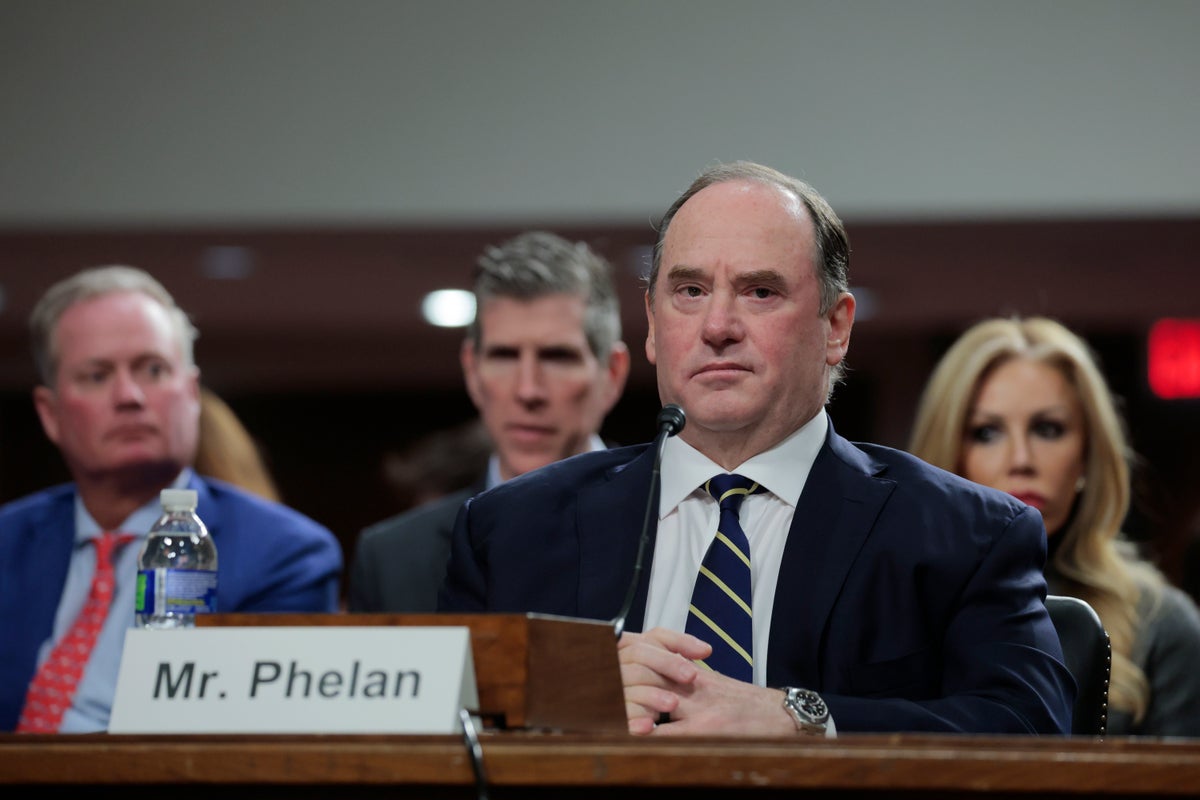
Navy Secretary John Phelan was asked to resign and replaced by Navy Undersecretary Hung Cao amid a broader Pentagon leadership reshuffle under Pete Hegseth. The article ties the move to disputes over shipbuilding priorities, the $9 billion-per-ship USS Defiant plan, and pressure to secure the Pentagon’s largest-ever budget request. It also highlights operational strain from the Iran naval blockade and the recommissioning of the USS Nimitz for another year after a delay to the new JFK carrier.
This is less about one personnel shake-up than about the deterioration of institutional process inside the defense apparatus. The market implication is a higher probability of procurement whiplash: program selection becomes more personality-driven, which tends to favor incumbents with political access and penalize contractors whose revenue depends on multi-year prioritization stability. In the near term, that raises execution risk across shipbuilding and naval modernization, but it can also temporarily accelerate “headline-friendly” platforms while starving lower-visibility maintenance, software, and logistics spend.
The second-order effect is budget composition risk, not absolute budget risk. If leadership is pushing a prestige fleet concept while aging assets are being extended in service, the eventual funding stack likely tilts toward a few large hulls, propulsion, weapons integration, and carrier life-extension rather than the broader distributed-fires architecture the Navy says it wants. That is bearish for suppliers tied to modularity, autonomy, and dispersed lethality narratives, and comparatively supportive of firms exposed to nuclear propulsion, carrier sustainment, combat systems integration, and depot-level maintenance. The real earnings risk is that program timing gets pulled forward in press releases but delayed in procurement, creating a gap between rhetoric and obligated spend.
For markets, the actionable question is whether this becomes a durable governance problem or just another leadership churn event. If the Pentagon’s internal conflict spills into contractor awards or a continuing resolution environment, the revenue impact shows up over months, not days, through award deferrals and wider bid spreads. If the administration doubles down, watch for a small set of shipbuilders and prime integrators to outperform on narrative, even as the broader defense complex underperforms on execution quality.
The contrarian view is that investors may be underestimating the value of continuity in shipbuilding when geopolitical pressure is rising. A more centralized chain of command can sometimes force faster budget decisions, and that can be a net positive for names with near-term capacity or yards already aligned to priority programs. The risk is that this works only if capital spending actually follows through; otherwise it becomes noise that increases volatility without improving order visibility.
AI-powered research, real-time alerts, and portfolio analytics for institutional investors.
Request TrialOverall Sentiment
mildly negative
Sentiment Score
-0.15
