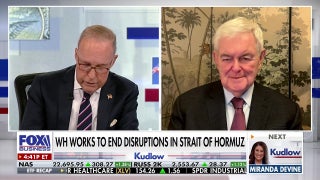
Oil fell to $85/bbl after topping $100 earlier and US stocks rallied roughly +200 points following President Trump's declaration that the conflict is 'very complete' and his push to reopen the Strait of Hormuz. OPEC data show world oil production at 106.3 million bpd vs demand of 105.5 million bpd through Q3 2025, suggesting available supply if disruptions are temporary. The administration plans US Navy protection and 'reinsurance guarantees' to reopen Hormuz 'probably a week or two,' which the author argues should limit prolonged inflation/recession risks. Investor guidance is to look through the war toward a bullish long-term economic outcome.
The immediate market reaction is masking two distinct regimes: a near-term security/insurance shock that spikes transport costs and volatility, and a medium-term geopolitical reallocation that, if resolved quickly, restores supply flows and compresses risk premia. Expect tanker insurance and freight-rate dislocations to persist longer than crude-freight fundamentals — even a week-long physical reopening still leaves a multi-week to multi-month reinsurance repricing that functionally adds an incremental $2–5/bbl cost-equivalent to oil-consuming sectors.
Second-order winners are not just upstream producers: refiners with light-sweet capacity (PSX, VLO) get margin tailwinds from tanker delays that favor arbitrage economics, while Gulf storage and pipeline servicers benefit from increased contango and storage demand. Conversely, logistics-heavy and spot-jet-fuel-sensitive sectors (airlines, container shipping) face outsized earnings volatility as short-run fuel and rerouting costs spike; these operational frictions can compress margins for 2–4 quarters even after flows normalize.
Catalysts to watch on tight timelines: visible US naval escorts, major P&I club reinsurance announcements, or a coordinated SPR release could re-price risk within 7–21 days and push Brent back down; asymmetric Iranian attacks or successful denial of Hormuz for >30 days would flip the script and sustain $95+ outcomes. Tail risks that would materially reverse the current bullish read include sustained tanker strikes, a rapid breakdown in reinsurance markets, or a diplomatic collapse that forces prolonged rerouting, each of which would propagate into shipping rates, container lead times, and broader inflation measures over 3–12 months.
AI-powered research, real-time alerts, and portfolio analytics for institutional investors.
Request DemoOverall Sentiment
strongly positive
Sentiment Score
0.75
