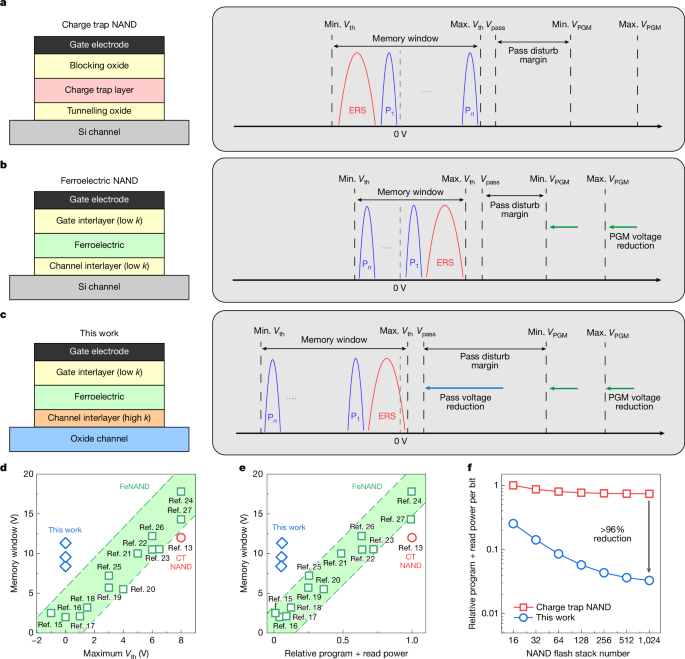
A research team demonstrated ultralow-power ferroelectric FETs (FeFETs) using zirconium-doped hafnia and an oxide-semiconductor channel that achieve up to 5 bits per cell and nearly zero pass voltage, enabling up to 96% power savings in string-level operations versus conventional NAND. The devices retain robust electrical properties when integrated in vertical 3D stacks with a 25 nm short channel, presenting a credible pathway to higher-density, lower-energy NAND/SSD products that could alter competitive dynamics and data-center energy economics if commercialized.
Market structure: FeFETs that deliver ~5-bit/cell and ~96% string-level pass-voltage power savings are a potential disruptive layer to charge-trap/FG 3D NAND economics — winners are advanced-memory toolmakers (process & BEOL), materials/IP owners for HfO2/HfZr/Ta2O5 and oxide-channel fabs; incumbents slow to adopt (smaller NAND vendors, legacy HDD-focused players) face ASP pressure. If scaled, effective usable capacity per wafer could rise >20–30% (bits per cell × lower overhead), pressuring NAND ASPs within 12–36 months unless demand from AI/datacenter outstrips supply growth.
Risk assessment: Tail risks include failed endurance/retention at enterprise temps, IP litigation, export controls on advanced fabs, or yield problems—any could delay commercial ramp by 12–36 months and wipe out expected margin upside. Near-term (days–months) reaction risk is headline-driven; medium (3–12 months) depends on partner/fab pilot announcements; long-term (1–3 years) depends on controller integration, ECC costs and foundry capacity expansion.
Trade implications: Tactical plays favor process-equipment suppliers (AMAT/LRCX), select memory leaders that invest in integration (MU, 000660.KS) and niche materials/IP owners; expect margin dispersion — implement asymmetric option exposure around partner announcements (3–9 months). Also prepare for NAND ASP compression scenarios by shorting slower adopters and using spreads to cap premium loss if adoption is slower than 12 months.
Contrarian angles: Consensus likely underestimates the multi-year adoption friction — 3D NAND transitions historically take 2–5 years; therefore upside for semicap and memory names is uneven and front-loaded to firms that secure foundry/design wins. Unintended consequences: higher bits/cell increases ECC/controller complexity, raising BOM costs and possibly offsetting raw bit-cost gains, so don’t assume a linear path to >30% margin expansion without verified controller partners.
AI-powered research, real-time alerts, and portfolio analytics for institutional investors.
Request DemoOverall Sentiment
moderately positive
Sentiment Score
0.45
