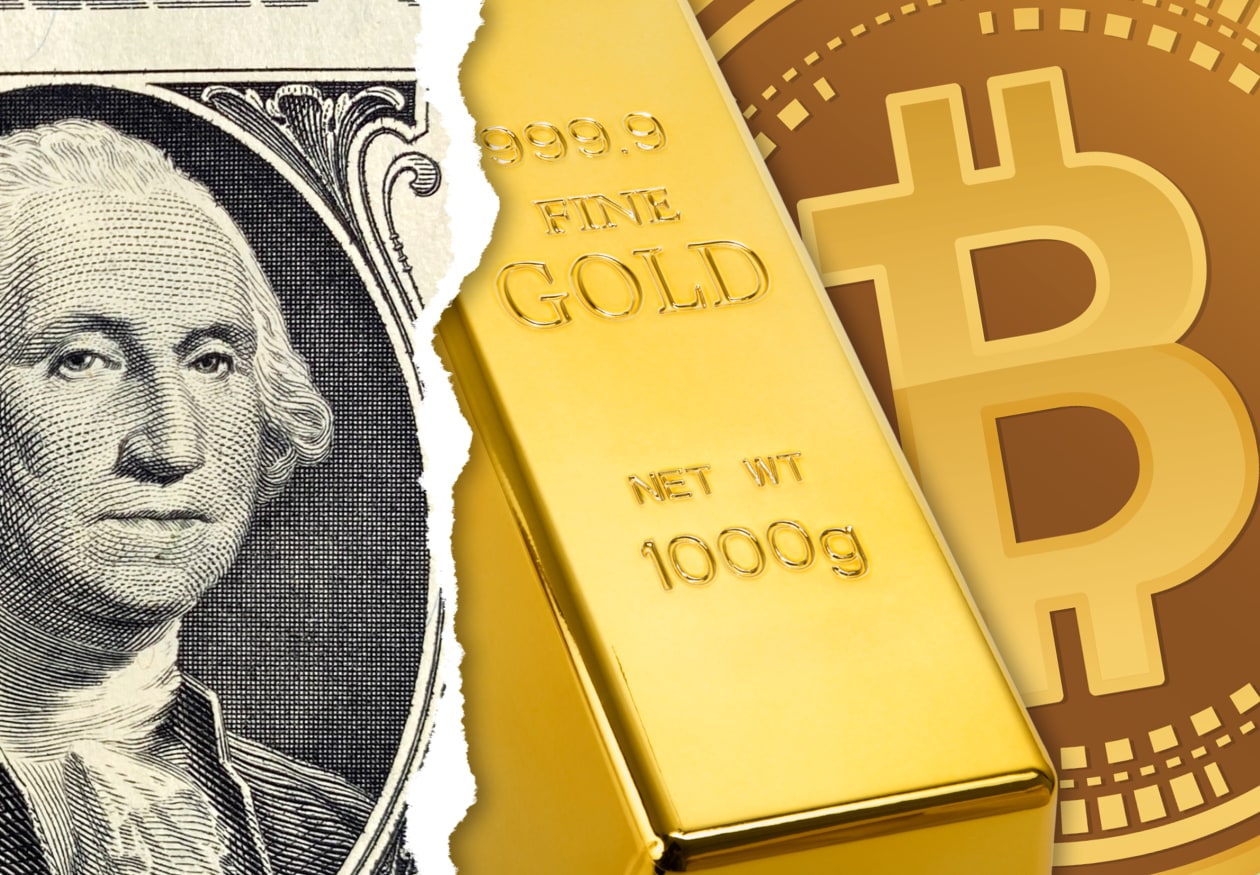
The 'debasement trade,' involving gold and Bitcoin as hedges against U.S. dollar weakness, is accelerating, with gold hitting a record $3,908.90/ounce and Bitcoin nearing $124,000, while the DXY has fallen approximately 10% year-to-date. This momentum is driven by structural concerns including persistent high U.S. government deficits (6-6.5% of GDP), long-term inflation uncertainty, and political dysfunction, rather than just short-term events like the government shutdown. Both individual and institutional investors are increasingly adopting this strategy, anticipating continued dollar debasement.
Market Snapshot How one of 2025’s most popular trades is boosting gold and bitcoin — and may keep going during the government shutdown The so-called debasement trade — embraced by individual investors since late 2024 as a hedge to a weaker dollar — could accelerate from here. The prospects of a further deterioration in the U.S. dollar’s value is at the heart of one of the year’s most popular trading themes. Investors have turned to assets like gold and bitcoin as a result, and it’s a trade that may have more room to run during the federal government’s partial shutdown. The so-called debasement trade, which individual investors began embracing just ahead of the November 2024 presidential election, has already gained momentum since the government shutdown started this past Wednesday. On Friday, gold for December delivery GCZ25 GC00 settled at a fresh record high of $3,908.90 an ounce on Comex — marking the 41st record-high settlement of the year for a most active contract — while bitcoin BTCUSD briefly rose to almost $124,000, near an all-time high. The ICE U.S. Dollar Index DXY, a measure of the greenback against a basket of six other currencies, slipped 0.1% on Friday, and is down roughly 10% for the year. The debasement trade — which involves a broad diversification away from fiat currencies such as the dollar — could pick up more steam regardless of whether the shutdown is short-lived or stretches beyond a week. That’s because of the number of persistent factors upon which it is based. These factors include lingering uncertainty over long-term inflation and the trajectory of U.S. fiscal policy; concerns about the independence of the Federal Reserve; and the prospect of persistently high deficits across major governments. Read: Government shutdown leaves investors in a data void. Here’s how they get around it. “The debasement trade has demonstrated strong momentum this year, with assets like gold and bitcoin generating strong returns,” said Matt Stucky, the Milwaukee-based chief portfolio manager of equities at Northwestern Mutual Wealth Management Co. “Falling real interest rates and a resumption of interest-rate cuts despite continued elevated inflation have added additional catalysts to the move higher.” History shows that the debasement trade does not always accelerate during periods of government shutdowns. And the dollar is still above the levels seen during the last U.S. government shutdown in 2018-19, which lasted 35 days and took place under the first Trump administration. However, the current government shutdown is “another data point to the continued dysfunction in the political system,” Stucky said in an email to MarketWatch. “This dysfunction has also led to continued federal deficits well beyond normal levels that are typically seen in economic expansions. High deficits and rising government debt have been bipartisan consequences, which last decades, and are additional tailwinds to the debasement trade.” Data from a team of strategists at J.P. Morgan, released during the past week, showed that the debasement trade accelerated in the third quarter as individual investors bought both gold and bitcoin exchange-traded funds, and that it has gained “significant traction” since the final three months of last year. Bitcoin-ETF flows saw greater momentum after President Donald Trump’s April 2 announcement of new tariffs and through July. Gold-ETF flows have been catching up since August, narrowing the gap with bitcoin ETFs, the J.P. Morgan strategists noted. Individual investors have embraced the debasement trade more than institutional investors in recent months, though the latter group is also joining this trading theme and has been buying both bitcoin and gold futures since 2024, the J.P. Morgan team noted. At Citi, analyst Alex Saunders said bitcoin is now seen as a form of “digital gold,” helping to explain the correlation between the two. Saunders has a 12-month price target of $181,000 on expectations for continued demand from investors. Komal Sri-Kumar, the former chief global strategist for TCW Group who is now president of a California-based consulting and strategy firm, said he prefers to view the debasement trade through the lens of gold. That’s because the precious metal has existed for centuries, and it’s not clear whether bitcoin, a much more novel asset, can withstand the various fluctuations in the market. In his view, the current shift to gold is based on the fear that various currencies are being debased due to worldwide tariffs and the prospect of slowing economies globally, alongside elevated inflation. “Right now, you cannot hide in the various currencies, which makes gold attractive,” Sri-Kumar said in a phone interview. Moreover, political pressure on the Federal Reserve may end up resulting in “much, much lower interest rates in the U.S.” and a pickup in both inflation and long-term yields — which “means you could lose money in bonds.” In his view, “we are going to clearly go over $4,000 in gold by the end of year.” Sri-Kumar added that “there’s no way to benefit from the safe-haven appeal of currencies when various currencies are being debased. I believe the rally in gold will still continue whether the government shutdown ends very quickly, or whether it continues for an extended period.” The factors that support the debasement trade will likely remain in place for quite some time, according to veteran fund manager Jeff Muhlenkamp of Pennsylvania-based Muhlenkamp & Co. Muhlenkamp has expressed serious doubts about the dollar since 2020-2021 due to fears of an eventual devaluation in the U.S. currency. His firm now has an 18% exposure to gold after boosting its holdings of the precious metal in the past few years. He described the government shutdown as being “a blip” in the grand scheme of things, and said that the real issue facing the U.S. is a more long-term structural problem. “We have, for years and years, kept an eyeball on government spending relative to GDP and in absolute terms,” Muhlenkamp told MarketWatch via phone. “We are now running a deficit that is 6% to 6.5% of GDP. With a high deficit-to-GDP ratio and a worsening picture, this got our attention and we said, ‘Our debt may become a problem.’” The problem “is getting worse, not better,” he added, and the deficit-to-GDP ratio would need to shrink by 1.5% to 2% in order to make a difference, which he doesn’t expect will happen for years. “I do not even think we are reducing the real debt burden yet, and I think this is very early days. We still have a long way to go,” Muhlenkamp said. Myra P. Saefong contributed. A potent 'debasement trade' is accelerating, driven by structural concerns over U.S. fiscal and monetary policy, leading to significant gains in gold and bitcoin. The U.S. Dollar Index (DXY) has fallen approximately 10% year-to-date, providing a powerful tailwind for this theme. Gold for December delivery has reached a new record high of $3,908.90 per ounce, while bitcoin has approached $124,000. This is not a short-term reaction to the current government shutdown, which analysts view as a 'blip', but rather a response to persistent underlying factors. These include a high federal deficit running at 6-6.5% of GDP, lingering inflation uncertainty, and questions about Federal Reserve independence amid political pressure for lower interest rates. J.P. Morgan data confirms that this trade, initially embraced by retail investors, is now gaining 'significant traction' with institutional participants who are buying both gold and bitcoin futures. Analysts project further upside, with Citi setting a 12-month bitcoin price target of $181,000 and others forecasting gold could exceed $4,000 by year-end, reinforcing the view that this is a long-term structural trend in its early stages.
AI-powered research, real-time alerts, and portfolio analytics for institutional investors.
Request DemoOverall Sentiment
strongly positive
Sentiment Score
0.75
Ticker Sentiment
