

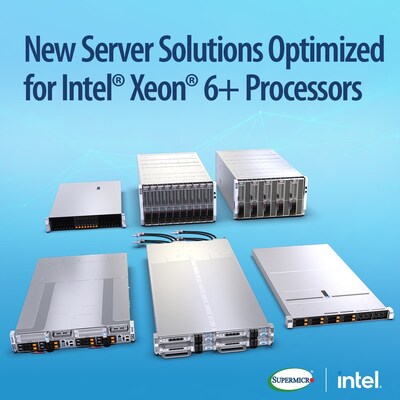
Supermicro launched 12 new server platforms optimized for Intel Xeon 6+ processors, with up to 576 efficiency cores per server and up to 288 E-cores per socket. The company says the new X14 systems improve performance-per-watt, lower TCO, and reduce energy consumption for cloud, virtualization, 5G analytics, and other high-density workloads. The announcement is positive for product breadth and competitiveness, but it is a routine launch rather than a near-term financial catalyst.
This is less a one-off product announcement than a positioning move in the enterprise refresh cycle: SMCI is trying to own the “density per watt” upgrade path before hyperscalers and telcos fully pivot to efficiency-core architectures. The second-order implication is that AI-adjacent infrastructure demand is broadening beyond GPU racks into the cheaper, higher-volume server tiers where procurement cycles are shorter and validation risk is lower. That matters because it gives SMCI a way to compound revenue even if AI capex pauses—these platforms can ride cloud-native, virtualization, and edge/networking budgets that are usually more resilient than frontier-model spend.
For INTC, the upside is more about ecosystem credibility than immediate unit economics. If these platforms ship meaningfully, Intel gets a stronger reference design story in a segment where AMD has been taking share on performance-per-watt and where OEM design wins can become sticky for multiple procurement cycles. But the market is likely to underappreciate the lag: design wins today do not translate into revenue leverage until customers qualify, deploy, and then reorder, which is a months-to-quarters process; any execution slip at either the silicon or board level would quickly turn this from narrative support into a dead-end.
The biggest hidden risk is margin quality at SMCI. Dense, thermally optimized platforms tend to increase system complexity, customization, and field-service burden, which can compress gross margin even as top line improves. In a higher-rate, higher-capex environment, investors may initially reward the order story, but over 1-2 quarters the stock can re-rate on evidence of whether mix and cooling/assembly costs preserve incremental profitability.
The contrarian view is that the announcement may be directionally positive but not economically transformative: efficiency-core servers are a feature race, not a moat. If customers see this as a routine refresh rather than a share-shifting platform shift, the multiple expansion in SMCI could stall once the launch premium fades. The more durable opportunity may be a relative trade: Intel benefits if it can prove competitiveness in dense enterprise workloads, while SMCI benefits only if it can convert engineering leadership into sustained margin discipline.
AI-powered research, real-time alerts, and portfolio analytics for institutional investors.
Request TrialOverall Sentiment
moderately positive
Sentiment Score
0.56
Ticker Sentiment
