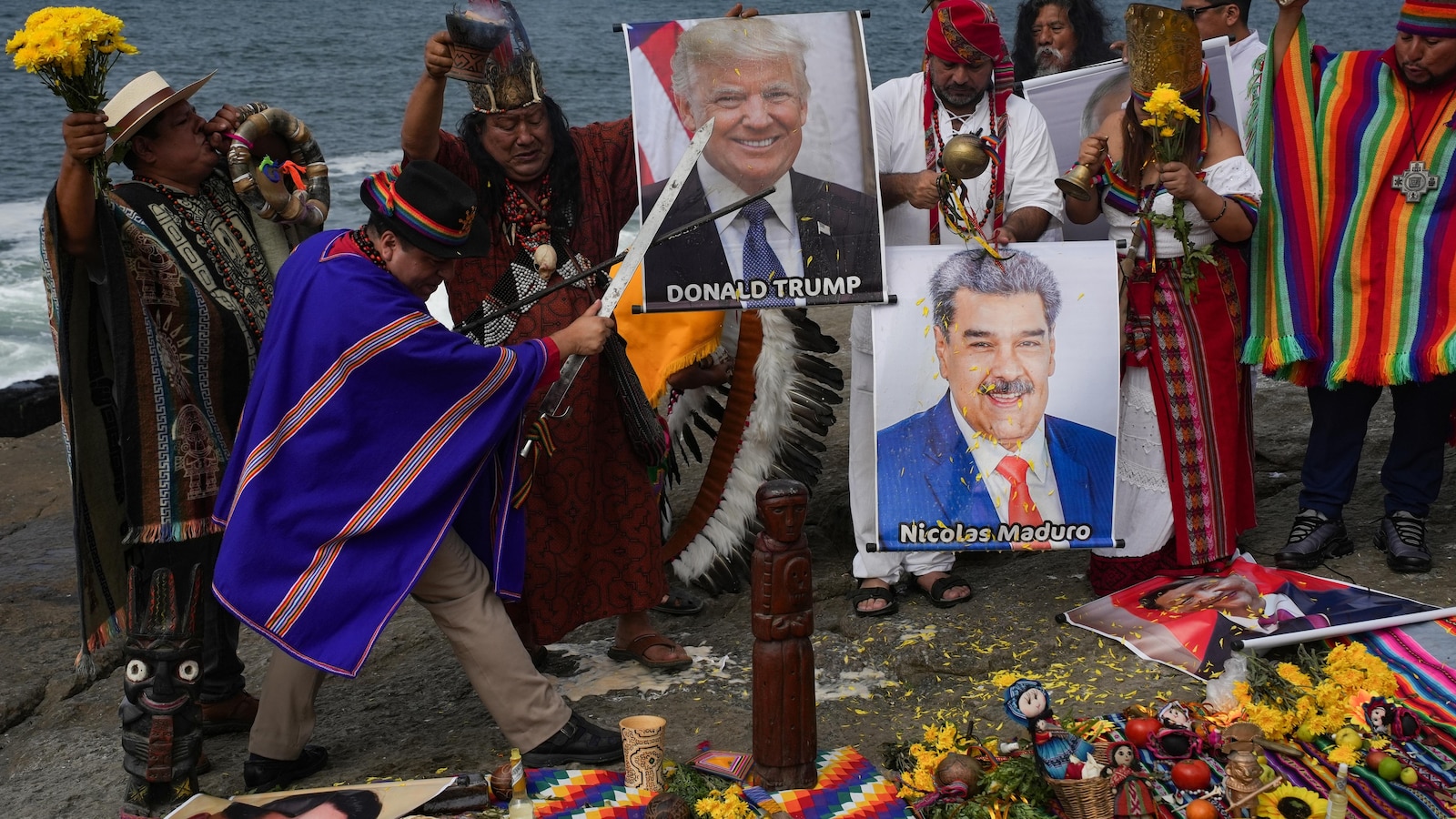
A group of Peruvian shamans held their annual Miraflores seaside ritual, claiming visions induced by Ayahuasca and San Pedro that Venezuelan President Nicolás Maduro will be removed from office and that international conflicts such as the war in Ukraine will continue into 2026; they also forecast earthquakes and climatic phenomena. The event is symbolic and carries no financial metrics, but the predictions underscore persistent geopolitical risk perceptions in Latin America that investors should note when assessing political risk exposure to Venezuela and regional emerging-market assets.
Market structure: The shaman story itself has negligible market impact, but the underlying hypothesis — potential removal of Nicolás Maduro — implies a pathway for Venezuelan oil (PDVSA) to re-enter markets. If sanctions ease and operations recover, plausible incremental supply is 0.3–0.8 mbpd over 6–18 months, which would put 3–8% downward pressure on Brent from current levels absent offsetting OPEC cuts. Short-term winners: defense contractors and safe-haven assets; medium-term winners/losers hinge on oil flow and sanctions policy. Risk assessment: Key tail risks are rapid regime collapse causing a temporary oil spike (supply shock) or a sudden sanctions lift creating a supply glut; probability of sanctions lift within 12 months I'd peg at ~10–20% with high uncertainty. Hidden dependencies: PDVSA’s damaged export infrastructure, debt/service claims, and OPEC+ political responses can delay any supply change by 6–24 months. Catalysts to watch in next 30–90 days: US policy statements, credible military defections, and tanker flows/PDVSA export volumes +100 kbpd moves. Trade implications: Favor asymmetric, small-size trades: short-duration Brent downside option exposure sized 0.5–1% of portfolio if you want to speculate on supply normalization, and a 1–2% defensive tilt into GLD (gold) and 1–2% long in high-quality defense names (RTX, LMT) as conflict continuation insurance. Reduce idiosyncratic LATAM equity risk (e.g., EPU) by 20–30% within 30 days; keep overall EM sovereign credit exposure underweight until PDVSA flows prove sustainable. Contrarian angles: Consensus will likely dismiss ritual predictions — that’s an advantage: markets underprice logistical frictions that prevent rapid Venezuelan supply returns, so large directional oil shorts are overdone. More plausible mispricing is concentrated in local EM sovereign and oil-service names that would re-rate only after tangible export increases; a patient 6–18 month option/calendar approach captures this asymmetry while capping downside.
AI-powered research, real-time alerts, and portfolio analytics for institutional investors.
Request DemoOverall Sentiment
neutral
Sentiment Score
-0.15
