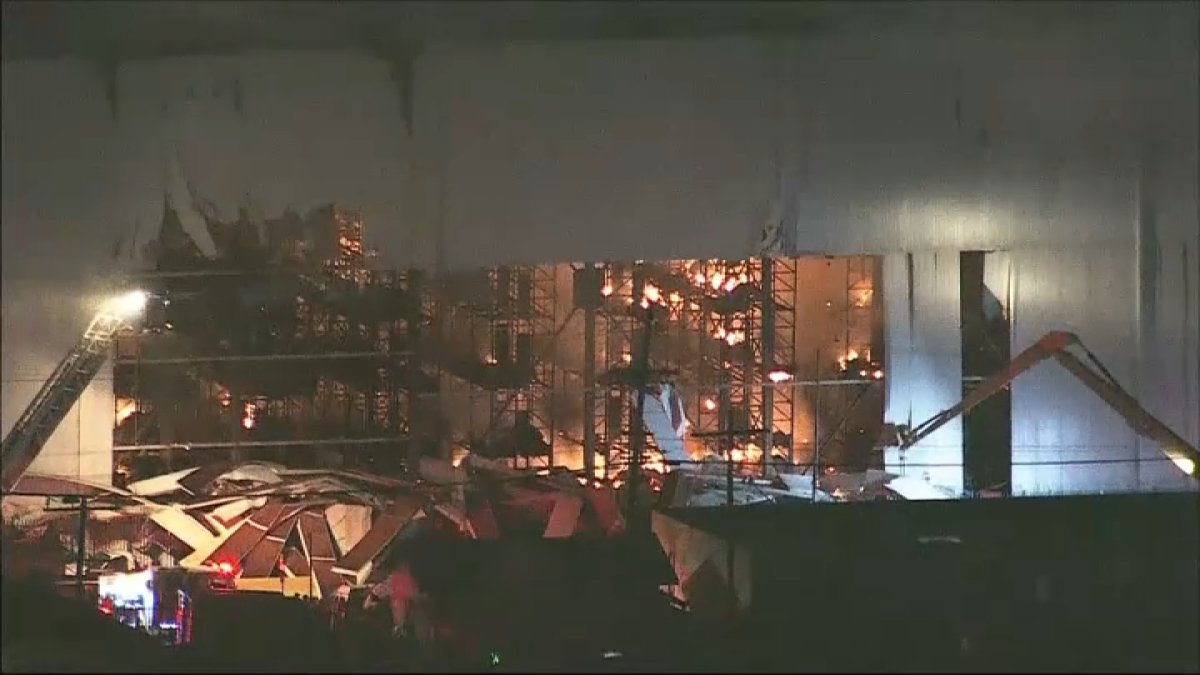
California declared a state of emergency in response to a multi-day fire at a Boyle Heights cold-storage facility, with 5.5 million N95 masks, air purifiers, bottled water, and air-quality monitoring being deployed. The blaze has triggered shelter-in-place orders, a smoke advisory, and a particle pollution advisory through 12:30 p.m. Sunday, with concerns that over 85 million pounds of decaying food could create biohazard conditions. The incident may have localized operational and logistics impacts, but the broader market effect is likely limited.
The immediate market read is not on the fire itself but on the probability of a wider operating disruption for cold-chain logistics in a dense urban corridor. For LINE, the bigger issue is less one facility-level loss and more the prospect of elevated scrutiny on refrigeration, hazardous materials handling, and urban warehousing permits across Southern California. If regulators treat this as a template case, the second-order effect is a slower approval cycle and higher compliance capex for any high-throughput refrigerated asset near population centers.
The short-term earnings hit to the company is likely manageable unless investigators find maintenance, insurance, or disclosure failures that extend the downtime into months. The more material risk is reputational: customers in food, pharma, and grocery distribution tend to re-source quickly after a safety event because service-level fragility is unacceptable. That creates a convex downside where one headline turns into contract churn well before any direct financial loss shows up in reported numbers.
The counterintuitive angle is that the broader cold-storage/logistics complex may not be uniformly damaged. Competitors with newer assets, stronger environmental controls, and suburban footprints could gain share if customers seek redundancy and lower local permitting risk. In that sense, the event could accelerate a modest re-rating dispersion within industrial REITs and logistics operators: legacy urban facilities face a discount, while best-in-class operators earn a scarcity premium.
The consensus likely underestimates how fast local and state response pressure can morph into policy. A one-off emergency declaration usually fades in days, but if air-quality complaints, worker safety concerns, or media attention persist for 2-6 weeks, expect tighter enforcement and a broader debate around warehouse siting. That is the key catalyst path for the next month: not burn severity, but whether the incident becomes a regulatory exemplar.
AI-powered research, real-time alerts, and portfolio analytics for institutional investors.
Request DemoOverall Sentiment
moderately negative
Sentiment Score
-0.45
Ticker Sentiment
