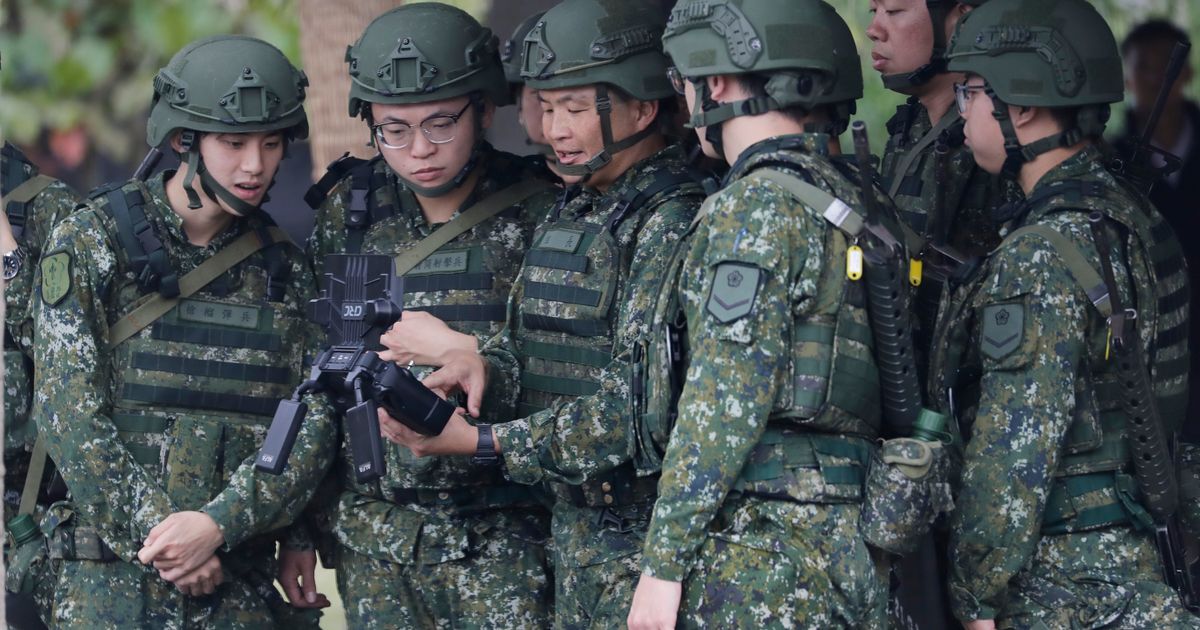
China has deployed substantial military force in drills around Taiwan amid long-standing sovereignty claims dating back to 1949, escalating regional tensions after recent weeks of political developments. The moves follow Japanese prime minister Sanae Takaichi's comments that Japan might not rule out intervention and a reported U.S. State Department proposal to sell more than $10 billion in arms to Taiwan — a package the article says would be the largest ever if approved by Congress and surpass the $8.4 billion under the previous administration. Beijing denounced the arms sale as harming its sovereignty and warned it could accelerate a slide toward military confrontation, a dynamic that elevates geopolitical risk for investors with exposure to regional supply chains and defense- and semiconductor-sensitive assets.
Market structure: Near-term winners are U.S. and allied defense primes and ETFs (pricing power on missiles, ISR, munitions); losers are Taiwan-headquartered semicap manufacturers and regional tourism/logistics firms because strike risk raises insurance and reroute costs. Expect 5–20% bid for defense order-books if the U.S. arms package clears Congress within 30 days; semiconductor supply tightness could push contract premiums and lead times +10–30% in affected nodes. Risk assessment: Tail risk is a kinetic disruption to Taiwan fabs causing 20–60% market-cap drawdowns for Taiwan-domiciled chip names and a global foundry shock lasting quarters; probability <10% in next 12 months but consequential. Immediate (days) — volatility/FX shocks; short-term (weeks–months) — defense revenue re-rate and elevated commodity/insurance premia; long-term (years) — accelerated onshoring and bifurcated tech supply chains benefiting cap‑equipment names. Trade implications: Tactical portfolio tilt to defense/ISR and safe-havens, hedging Taiwan semiconductor exposure. Use size-constrained option hedges (tail puts on TSM) and call-spreads on large defense names to control premium. Expect to scale in 48–72 hours and re-evaluate on two catalysts: Congressional arms approval (30d) and any announced PLA exclusion zones. Contrarian angles: Consensus may overprice immediate kinetic risk and underprice the structural winners from bifurcation (ASML, LRCX, AMAT) who benefit from onshoring capex; a short-lived panic could create buying opportunities in high-quality Taiwan chip stocks if implied vol >25–30%. Historical parallels (1996 Strait crisis) show short-lived equity shocks with durable defense budgets — trade the knee-jerk but keep tail insurance live.
AI-powered research, real-time alerts, and portfolio analytics for institutional investors.
Request DemoOverall Sentiment
moderately negative
Sentiment Score
-0.45
