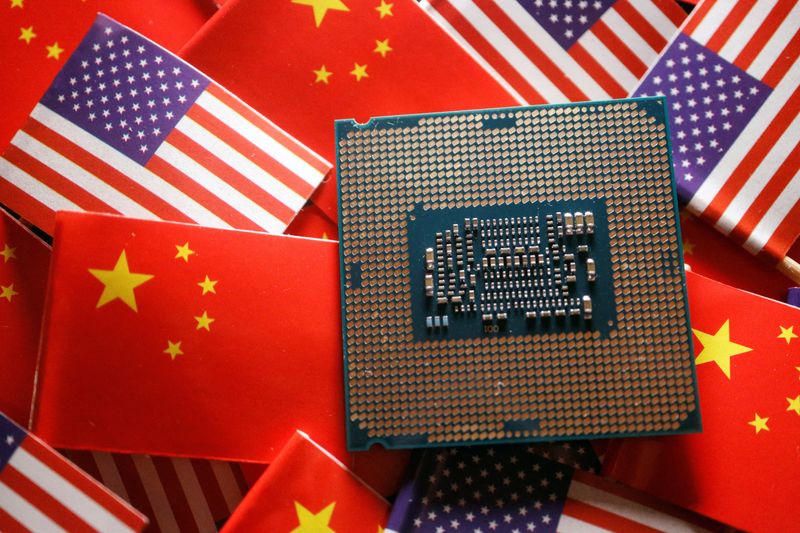
Beijing warned that new bipartisan U.S. export-control bills could severely destabilize global semiconductor supply chains, with the House Foreign Affairs Committee already advancing measures to restrict advanced AI and chip technology exports to China. The proposed crackdown raises the risk of retaliatory Chinese actions, including curbs on rare earths or other critical inputs, and reinforces the outlook for prolonged tech-sector decoupling. The news is likely to pressure semiconductor sentiment and increase volatility across the chip supply chain.
The first-order read is negative for the semiconductor complex, but the second-order winners are likely to be the tooling, test, and materials names with the least China revenue concentration and the most pricing power. If export controls tighten, customers will front-load procurement before implementation, which can create a temporary air pocket followed by a “pull-through” lull for several quarters; that favors suppliers with backlog visibility and high consumable content over pure capital-equipment levered names. The more durable beneficiary is domestic AI infrastructure outside China, where constrained access to leading-edge Asian capacity should keep capex rotating toward U.S./ally fabs and localized supply chains.
The biggest underappreciated risk is not a one-day multiple compression; it is a regime shift in supply-chain architecture that raises inventory, compliance, and qualification costs across the stack. That typically compresses gross margins for assemblers and OEMs while expanding working capital needs, so the earnings damage often shows up 1-3 quarters after policy headlines, not immediately. A second-order loser is any company with meaningful exposure to legacy-node China demand and high Chinese endpoint concentration, because retaliatory rare-earth or specialty-material measures can hit broader hardware ecosystems even if the original rule targets advanced tools.
The contrarian view is that the market may already be discounting more restrictions than Congress can actually implement, especially if lobbying dilutes enforcement or exemptions proliferate. That creates a tactical setup for a brief selloff in the most China-sensitive semiconductor names, followed by a rebound once investors conclude the actual rule set is narrower than the rhetoric. The real asymmetry is in dispersion: broad index shorts are less attractive than relative shorts against the most exposed China revenue pools.
Time horizon matters: the headline reaction is days, the inventory and capex effects are months, and the strategic bifurcation trade is multi-year. If Beijing responds only rhetorically, the bearish impulse fades quickly; if it targets upstream materials, the impact broadens materially and becomes a supply shock rather than just a demand/regulatory shock.
AI-powered research, real-time alerts, and portfolio analytics for institutional investors.
Request DemoOverall Sentiment
moderately negative
Sentiment Score
-0.45
