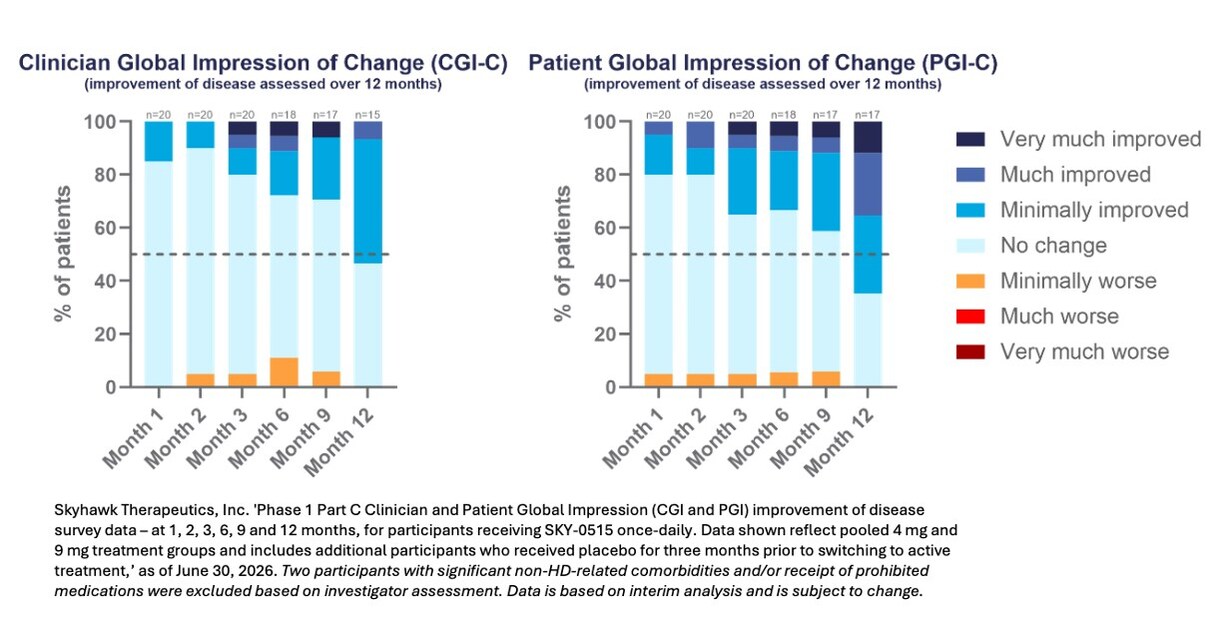
Skyhawk Therapeutics reported favorable 12-month cUHDRS subcomponent results for SKY-0515: TFC improved by +0.07 vs expected -0.87, TMS by -2.00 vs expected +2.21, SDMT stabilized at -0.19 vs expected -1.78, and SWRT improved +3.44 vs expected -3.13. Clinician/patient CGI/PGI showed no worsening at 12 months, with 65% of participants and 50% of clinicians reporting improvement, alongside dose-dependent biomarker reductions (mHTT in blood up to 69%; PMS1 mRNA up to 26%). Program-wise, Phase 1/2 enrollment is complete and the Phase 2/3 FALCON-HD study is advancing (004-ANZ enrollment complete; 004-WW plans up to 400), with SKY-0515 positioned as a daily oral RNA splicing modifier.
This is more meaningful as a platform de-risking event than as a near-term revenue story. The key market mechanism is not “HD progress” in the abstract; it is whether an oral small-molecule RNA modulator can achieve biomarker suppression and apparent functional stability well enough to compete against injectable CNS modalities on convenience, manufacturing, and ultimately patient adoption. If the signal survives the blinded extension and pivotal phase, it raises the bar for rival HD programs that rely on harder-to-administer or less clearly differentiated approaches.
The first-order winners are likely any company with adjacent CNS or RNA-splicing credibility, because the readthrough is that oral target engagement in brain disease is becoming more financeable. The first-order losers are the incumbent HD therapeutic narratives that depend on invasive delivery or on biomarkers without clean functional linkage; that puts pressure on WVE and QURE sentiment more than on broad biotech. The second-order effect is valuation multiple expansion for “platform” stories only if they can show repeatability across indications; otherwise this remains a single-asset clinical win, not a platform re-rate.
The main risk is duration and durability: the strongest data here are still vulnerable to small-sample bias, unblinding, and selection effects over 12 months. The real catalyst path is 1-3 months for market enthusiasm and financing leverage, but 6-18 months for whether the phase 2/3 package converts into a convincing regulatory path. What would falsify the thesis is any loss of biomarker suppression, a plateau in functional measures versus natural history, or safety/tolerability issues once exposure broadens in the pivotal cohort.
Contrarian view: the market may overprice the “daily pill” angle before seeing whether magnitude of mHTT lowering translates into clinically meaningful slope changes. If the signal proves real, the bigger upside may be in follow-on financing optionality for Skyhawk rather than immediate sector beta; if not, the relative short should be the most richly valued HD developers rather than the broader biotech tape.
AI-powered research, real-time alerts, and portfolio analytics for institutional investors.
Request DemoOverall Sentiment
moderately positive
Sentiment Score
0.60
Ticker Sentiment
