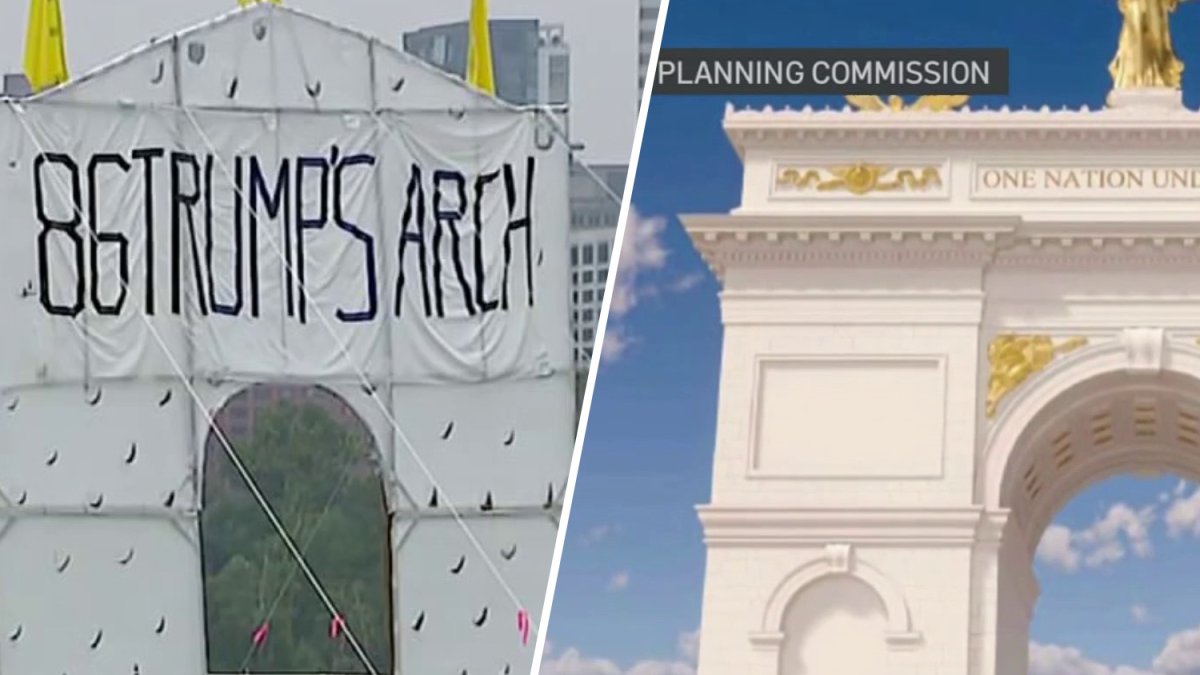
A proposed 250-foot arch honoring President Donald Trump moved one step closer after the U.S. Commission of Fine Arts approved the design, but the project still faces a lawsuit from Vietnam veterans and questions over whether Congress must approve it. Protesters began demonstrations near the Lincoln Memorial, and the dispute centers on land ownership and the legality of building a memorial to a living president. The story is politically charged but unlikely to have broad market impact.
This is a slow-burn governance and permitting trade, not a direct market catalyst. The main signal is that symbolic projects tied to the federal real estate complex can become proxy fights over executive overreach, land-use authority, and memorial policy, which tends to widen bid/ask spreads for anything adjacent to DC-area public works and federal property utilization. The second-order effect is reputational: once an asset is framed as a partisan monument rather than civic infrastructure, the approval path gets materially more fragile and the odds of schedule slippage rise in months, not days.
The near-term market implication is mostly on legal and construction optionality. A lawsuit plus congressional-approval dispute creates a two-step gating process: even if one venue clears, the other can still stall capital formation, procurement, and contractor mobilization. That favors parties with low fixed-cost exposure and hurts firms that would need to pre-position labor, materials, or permitting budgets before final authority is settled.
The contrarian angle is that the project’s highest-value asset may be the controversy itself. If the fight persists, it increases the probability of political bargaining, design revisions, or relocation, which could eventually convert an all-or-nothing outcome into a smaller, less controversial, and more buildable scope. In that scenario, the bearish case on the project is less about cancellation and more about value leakage through delay, legal expense, and a reduced construction package.
For portfolio construction, this is better treated as a catalyst watchlist than a directional macro view. The main risk is a sudden administrative or legislative clarification that collapses the uncertainty and brings the project back on schedule; the upside case for shorts in legal/process-sensitive names would then fade quickly. Absent that, the more durable setup is for headline-driven volatility with limited fundamental follow-through over the next 1-3 months.
AI-powered research, real-time alerts, and portfolio analytics for institutional investors.
Request DemoOverall Sentiment
neutral
Sentiment Score
-0.10
