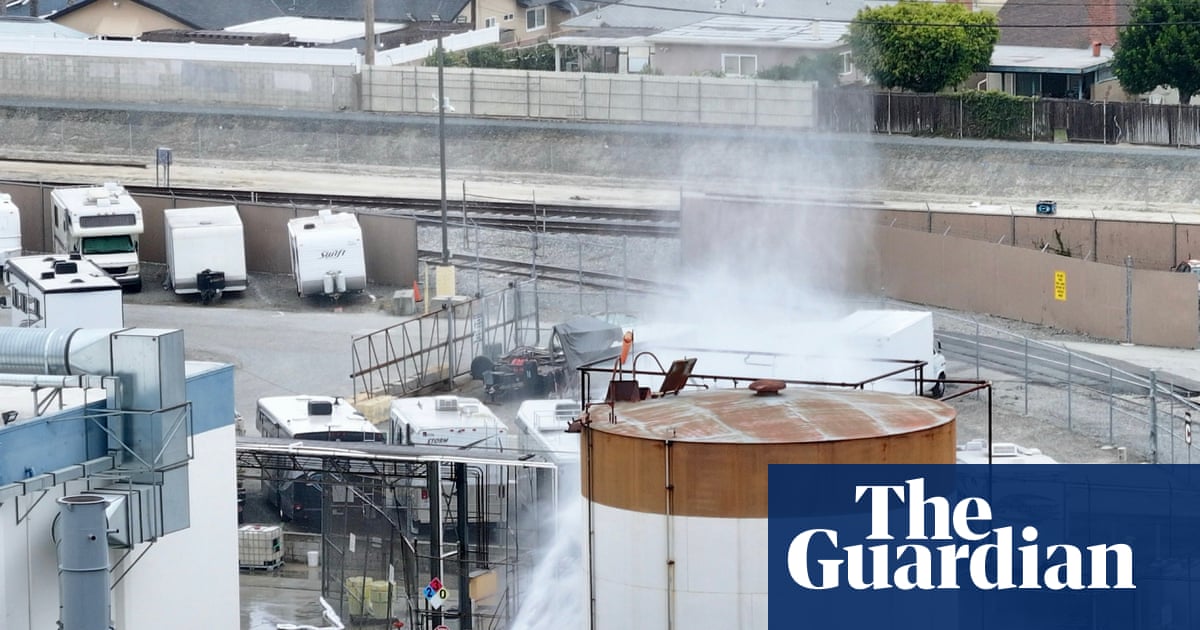
California declared a state of emergency as 40,000 Orange County residents were ordered to evacuate after a 6,000-7,000 gallon methyl methacrylate storage tank at a Garden Grove GKN Aerospace facility began off-gassing and threatened to fail. Responders are attempting cooling, neutralization, and contingency diking/damming measures, but the tank temperature has reportedly risen to 90F, about 13 degrees above the prior reading and near 1 degree per hour higher. The incident raises material public safety and environmental risks and could have localized operational consequences for the facility and surrounding area.
The immediate market impact is less about the headline hazard and more about the operational shock to a dense Southern California manufacturing/logistics node. Even if the incident is contained, nearby industrial users face precautionary shutdowns, trucking delays, hazmat restrictions, and higher insurance scrutiny; those effects can ripple for days and potentially linger for weeks if regulators widen inspections. The most exposed second-order losers are specialty chemical distributors, local industrial real estate, and any aerospace or advanced-manufacturing suppliers with just-in-time inventory in Orange County.
The biggest medium-term beneficiary is not a single listed company but the regulatory premium embedded in infrastructure-adjacent assets: firms with stronger compliance, redundant storage, and offsite capacity may gain share as customers reassess single-site concentration risk. Defense/aerospace supply chains could see temporary schedule slippage if the affected facility or its neighbors support machining, coatings, or resin inputs, which matters because even a short interruption can trigger contractual penalties and accelerate qualification of alternate vendors. In that sense, the event is a small but useful reminder that industrial resilience is becoming a competitive advantage, not just a cost center.
The contrarian angle is that the market may over-discount a broad “industrial disaster” read-through when the more durable impact is likely local and episodic. Unless there is a broader discovery of stored-hazard weaknesses across similar facilities, this should fade from a national macro lens within 1-3 weeks, while the litigation/cleanup overhang can last months. The real tail risk is if responders fail and there is a wider evacuation or air-quality incident, which would amplify political pressure for tighter chemical-storage rules and could create a multi-quarter compliance capex cycle for regulated industrials.
AI-powered research, real-time alerts, and portfolio analytics for institutional investors.
Request DemoOverall Sentiment
strongly negative
Sentiment Score
-0.55
