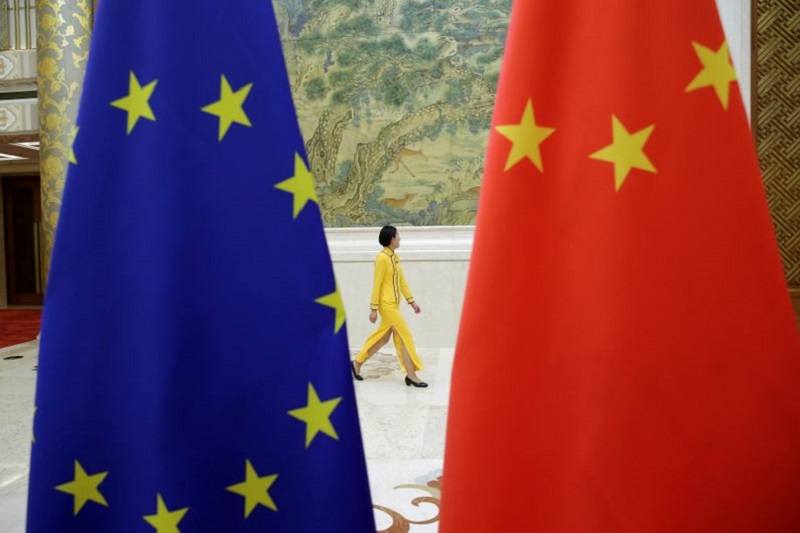
The EU is advancing a proposal that could force companies to diversify supply chains if more than 40% of stock comes from a single supplier, as Brussels seeks to reduce dependence on China. The bloc is responding to a €360 billion trade deficit, Chinese control over key inputs such as semiconductors and rare earths, and concerns over subsidized imports. The move raises the risk of tighter trade restrictions and potential retaliation from Beijing, though officials are still trying to avoid a full trade war.
The market is underappreciating that this is not just a China headline; it is a structural procurement-tax on any company whose moat depends on ultra-cheap, single-source Asian inputs. The first-order hit is obvious for suppliers with concentrated manufacturing in China, but the second-order effect is a widening of working-capital needs and unit costs across the industrial tech stack, which tends to compress margins before volumes even roll over. That dynamic is most relevant for hardware names with low pricing power and long inventory cycles, where a forced multi-sourcing transition can add 100-300 bps of COGS inflation over the next 2-4 quarters.
For SMCI, the risk is less about direct tariff pain and more about operating leverage to supply-chain friction: if customers and OEM partners start demanding regional redundancy, the company may face higher component qualification costs, longer lead times, and potentially lower gross margins during transition periods. APP is less exposed operationally, but it can still trade as a high-beta proxy for crowded AI/tech sentiment; if this policy regime becomes a broader de-risking narrative, multiple compression can hit even names with cleaner supply chains. The key second-order loser may be smaller hardware peers and contract manufacturers that cannot fund inventory diversification without balance-sheet strain.
The main contrarian point is that this proposal may be more important as a negotiation tool than as an immediately binding revenue shock. If Brussels uses the threat of forced diversification to extract concessions, the market could fade the headline within days, especially if implementation is pushed into a multi-year consultation process. However, once procurement teams begin qualifying alternate suppliers, the change becomes sticky; the real bear case is not an abrupt ban, but a slow erosion of China-centric cost advantages that compounds over 12-24 months.
Catalyst-wise, the next 2-8 weeks matter for headline risk, but the investable window is 3-6 months as companies guide on sourcing, inventory, and margin assumptions. Any signal that Beijing is willing to retaliate on rare earths, advanced components, or customs enforcement would accelerate the downside for hardware supply chains and extend the duration of the trade. Conversely, if the EU softens the language or exempts strategic sectors, this becomes a fading event rather than a secular repricing.
AI-powered research, real-time alerts, and portfolio analytics for institutional investors.
Request DemoOverall Sentiment
mildly negative
Sentiment Score
-0.20
Ticker Sentiment
