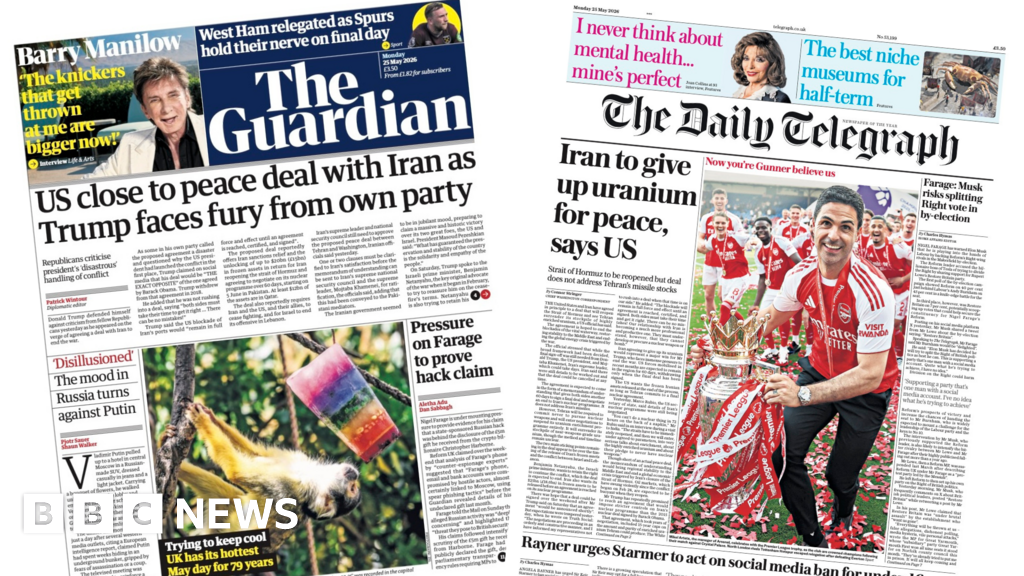
The article is a media roundup centered on US-Iran peace talks, with reports that Trump is instructing negotiators not to rush and that talks are still dragging on. It also flags political pressure on Nigel Farage over a claimed Russian hack, plus assorted UK domestic stories on policing, housing, and party politics. Overall the piece is informational and broad-based, with limited direct market implications beyond geopolitical risk sentiment.
The market implication here is less about the headline diplomacy and more about the distribution of outcomes for energy, defense, and cyber risk. A credible path to lower Iran-related tensions compresses the geopolitical risk premium in crude and refined products, but only on a lag: physical barrels do not appear instantly, while headline-driven risk-off can unwind in days. That makes the first-order trade a short-duration volatility fade in oil-linked equities rather than a structural short if negotiations remain fragile.
The second-order loser is the defense complex only if the talks materially reduce the probability of regional escalation; otherwise, defense demand remains buffered by Europe/Ukraine and domestic procurement cycles. In contrast, any durable de-escalation would likely be a modest positive for transport, airlines, and chemical feedstocks through lower input costs and improved risk appetite. The bigger macro tell is that markets are still pricing a premium for unresolved conflict, so the downside in crude can be sharper than the upside if talks unexpectedly crystallize.
The cyber/privacy angle is more idiosyncratic but not trivial: the more politically charged the information environment, the higher the odds of retaliatory hacks, leaks, and sanctions noise. That supports a barbell in cyber names with recurring government spend and subscription revenue, while penalizing firms with reputationally sensitive exposures or weak compliance optics. Meanwhile, domestic politics around housing and policing are noise for broad indices but can influence UK small-cap sentiment and homebuilder policy expectations over the next 1-3 months.
The contrarian view is that the consensus is overestimating the durability of any peace premium compression. Negotiations that drag on with mixed messaging often increase realized volatility, not reduce it, because energy traders sell the first headline and buy back on every setback. If talks fail or stall, the snapback in crude, defense shares, and safe-haven assets can be swift within 1-2 sessions, especially if positioning has leaned too far toward de-escalation.
AI-powered research, real-time alerts, and portfolio analytics for institutional investors.
Request DemoOverall Sentiment
neutral
Sentiment Score
-0.05
