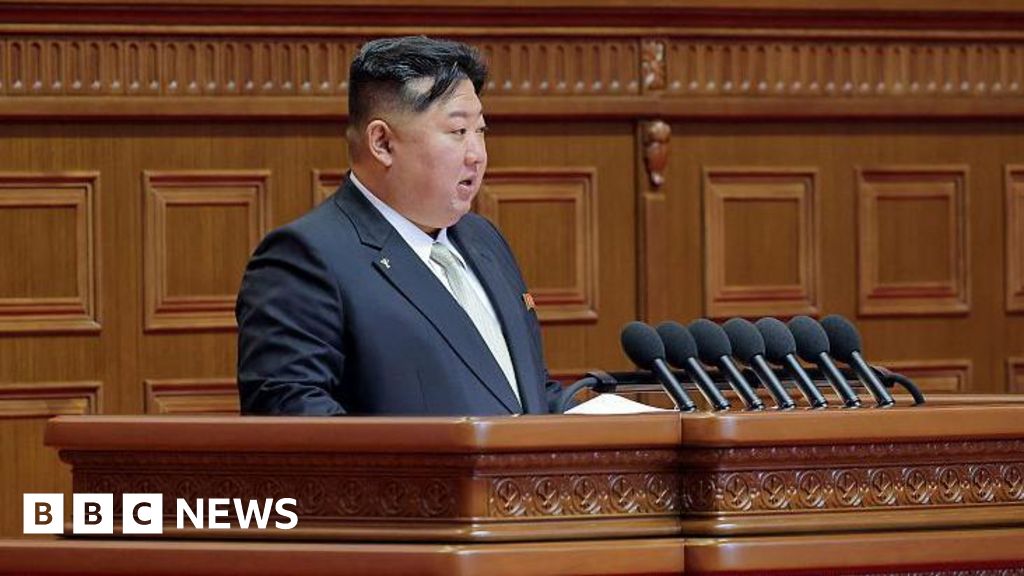
North Korea's Workers' Party reaffirmed Kim Jong Un as general secretary at the Ninth Party Congress, underscoring leadership continuity while state media touted strengthened nuclear forces. The congress — attended by some 5,000 members and marked by a substantial reshuffle of the presidium — signals policy priorities including an emphasis on nuclear-capable systems and economic development, against the backdrop of long-standing international sanctions. Market-relevant implications are primarily geopolitical risk and regional defense tension rather than immediate economic shocks, with potential longer-term effects on regional stability and sanctions dynamics.
Market structure: Re-affirmation of Kim Jong Un raises tail geopolitical risk for the Korean peninsula, benefiting global defense primes (LMT, RTX, NOC) and safe-havens (USD, JPY, gold) while pressuring South Korean equities, exporters and KRW. Defense demand is likely to firm marginally—expect a 3–7% near-term re-rating window for tier-1 contractors on incremental order visibility and political support, while Korean equity risk premia can widen 5–15% on volatility spikes.
Risk assessment: Low-probability/high-impact tails include a major military provocation or miscalculation that triggers broad sanctions or kinetic conflict—this would spike oil +5–15% and gold +8–20% and force regional supply-chain shocks. Immediate (days): risk-off flows; short-term (weeks–months): FX and equity volatility; long-term (quarters–years): sustained defense budgets and accelerated regional capex re-shoring. Hidden dependencies: Chinese diplomatic tolerance and insurance/shipping disruptions for Korean exporters are the second-order transmission mechanisms.
Trade implications: Tilt portfolios toward 6–12 month overweight in U.S. defense primes (LMT, RTX, NOC) and 1–2% tactical gold (GLD) allocation; hedge Korea-specific exposure via 3-month ATM puts on EWY and 3-month USD/KRW calls (strike ~+3% from spot). Use options to size convex protection: buy EWY puts sized 0.5–1% portfolio and buy a 2–3 month VIX call spread (small notional) as cheap tail insurance.
Contrarian angles: Markets may overstate DPRK technological progress—sanctions and opacity constrain true capability, so long-duration defense multiple expansion is not guaranteed and is priced in. A 10–15% pullback in Korean semis (005930.KS, 000660.KS) could create a buying opportunity; conversely, Korean defense suppliers (e.g., Hanwha-related names) may be under-owned and rerate if Seoul increases domestic procurement.
AI-powered research, real-time alerts, and portfolio analytics for institutional investors.
Request DemoOverall Sentiment
moderately negative
Sentiment Score
-0.30
