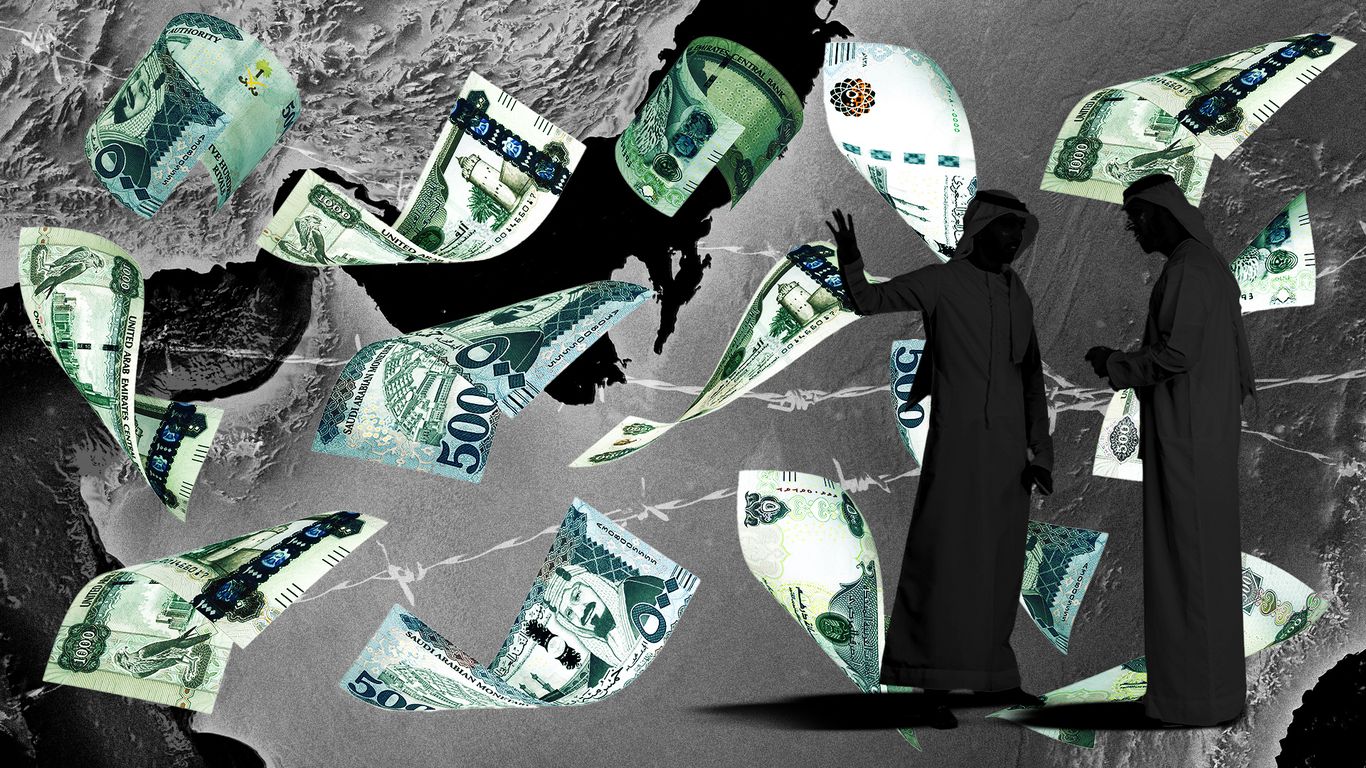
The Gulf’s post-oil investment story has taken a major hit as Iran’s war dynamics strain UAE-Saudi relations, disrupt tourism confidence, and cool plans for large-scale AI and capital projects. The UAE is leaving OPEC to pump oil on its own terms, while Saudi Arabia’s $5+ billion LIV Golf exit signals pressure on prestige spending amid weaker oil exports. The article suggests Trump-era Gulf investment pledges, including the UAE’s $1.4 trillion U.S. commitment, are now in limbo.
The market is underpricing the regime shift from “Gulf as global growth sponsor” to “Gulf as selective capital allocator under security stress.” That matters for private markets and AI infrastructure because the cheap-capital narrative depended on political stability more than on balance-sheet capacity; once that premium is compromised, hurdle rates rise and project IRRs compress, especially for long-dated, power-hungry data center builds in hostile-range geography. Expect a second-order hit to U.S. capex beneficiaries that were trading on Gulf-funded expansion assumptions: construction, power equipment, and semiconductor-adjacent infrastructure should see the most de-rating first.
Energy is the cleaner tactical winner, but not because of a supply shock alone; it is because both Saudi and the UAE now have stronger incentives to maximize near-term monetization and preserve fiscal optionality, which should keep OPEC+ cohesion weaker and raise the variance around future production policy. The UAE’s move signals that the cartel’s political discipline is breaking exactly when external security risk is increasing, a combination that historically produces higher term premiums in oil and more attractive realized pricing for upstream equities than for integrateds. A sustained risk premium of even $5-8/bbl would be enough to re-rate select E&Ps, while the same instability suppresses tourism, retail, and real estate multiples across the Gulf.
The deeper loser is the “safe luxury destination” trade, which had been a structural growth story for travel, hospitality, and high-end consumer proxies exposed to Gulf demand. If insurers and corporate security teams revise their assumptions on physical risk, the impact will show up over quarters through fewer conferences, weaker premium occupancy, and slower FDI conversion rather than through immediate headline damage. This is also a negative for cross-border capital recycling into U.S. venture and infrastructure funds: sovereigns may still pledge, but commitment velocity and follow-on checks likely slow materially.
Consensus is treating the rift as a temporary wartime distortion, but the more important shift is strategic decoupling among Gulf states themselves. If that persists, the market should expect less coordinated capital deployment, more fragmented energy policy, and a lower probability of large normalization deals in the next 6-12 months. The upside scenario is that the security umbrella holds and investment resumes; absent that, the current de-risking is likely the start of a multi-year repricing, not a headline blip.
AI-powered research, real-time alerts, and portfolio analytics for institutional investors.
Request DemoOverall Sentiment
strongly negative
Sentiment Score
-0.62
