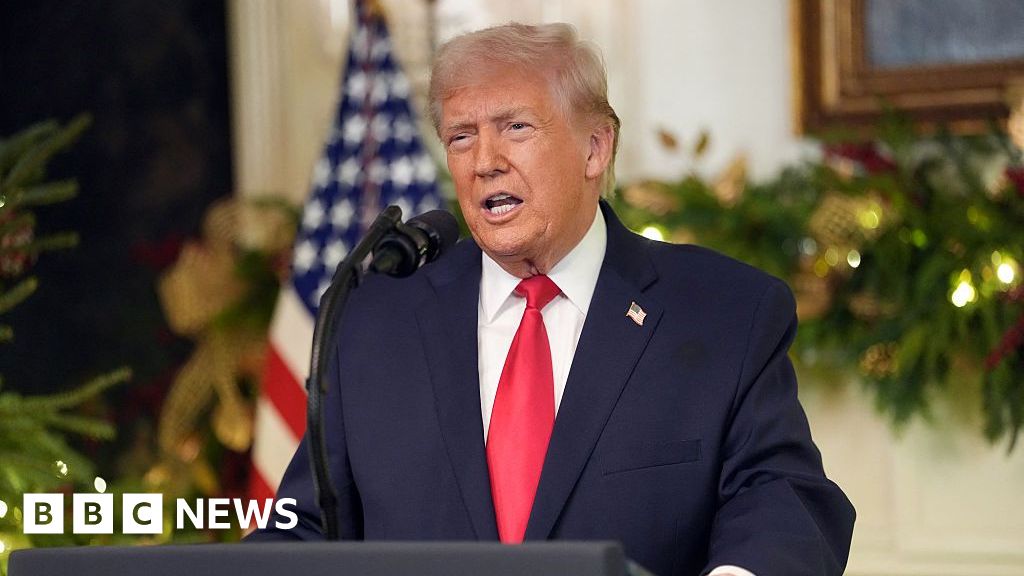
President Trump announced a $1,776 "warrior dividend" to 1.45 million US service members—a $2.57bn one‑time payout he says is funded in part by tariffs and recent legislation—promised to arrive before Christmas. The move is positioned as a political gesture amid persistent inflationary pressures (US inflation at ~3% in September) and weakening consumer confidence, underscoring administration efforts to counter voter concern about cost of living; the fiscal impulse is small relative to the economy and unlikely to move markets materially, though trade/tariff funding and election optics bear watching.
Market structure: The $1,776 “warrior dividend” (total $2.57bn) is economically tiny vs US GDP but concentrated — 1.45M service members will receive an average one-off boost equivalent to ~1–2% of annual household income for lower‑income military households, implying a near‑term marginal consumption uplift in local retail, quick‑service restaurants and consumer discretionary stores located near bases. Tariff‑funding signals sustained protectionism: import‑reliant retailers and branded apparel/consumer electronics (higher input costs) are vulnerable to margin compression while domestic producers and logistics providers may pick up share or pricing power.
Risk assessment: Tail risks include tariff escalation or foreign retaliation that elevates import prices and core CPI materially (+50–100bps) over 3–6 months, forcing tighter financial conditions and re‑pricing 10Y yields by +25–50bps. Immediate (days) effects are retail spending bumps and POS data surprises; short (weeks–months) hinge on December retail sales/CPI prints; long (quarters) depend on persistence of tariff policy and midterm political outcomes. Hidden dependency: the move is political signaling more than durable fiscal support — firms may price in sustained tariffs even if the payments are one‑off.
Trade implications: Tactical long bias to militarily concentrated consumer plays (WMT, TGT, MCD, YUM; XLY/XRT ETFs) into Dec/Jan retail data; short selective import‑sensitive apparel/brand names (PVH, RL) and small retailers with thin FX hedges. Use cost‑limited options (call spreads on WMT/MCD) to capture holiday upside while hedging with short call exposure on importers. Rebalance after Jan CPI/retail prints and after midterm funding/legislation clarity.
Contrarian angles: Consensus overstates macro impact; markets may underprice the corporate earnings hit from ongoing tariffs — look for mispricings where domestic cyclicals are cheap relative to multinationals that will suffer persistent input cost inflation. Historical parallel: 2008/2011 one‑off rebates produced short blips in consumption but no durable trend; thus favor trades that harvest a 4–12 week window rather than multi‑quarter bets. Unintended consequence: tariffs could widen wholesale/consumer price dispersion and create idiosyncratic winners (US inputs, regional banks) and losers (global supply chain incumbents).
AI-powered research, real-time alerts, and portfolio analytics for institutional investors.
Request DemoOverall Sentiment
moderately negative
Sentiment Score
-0.30
