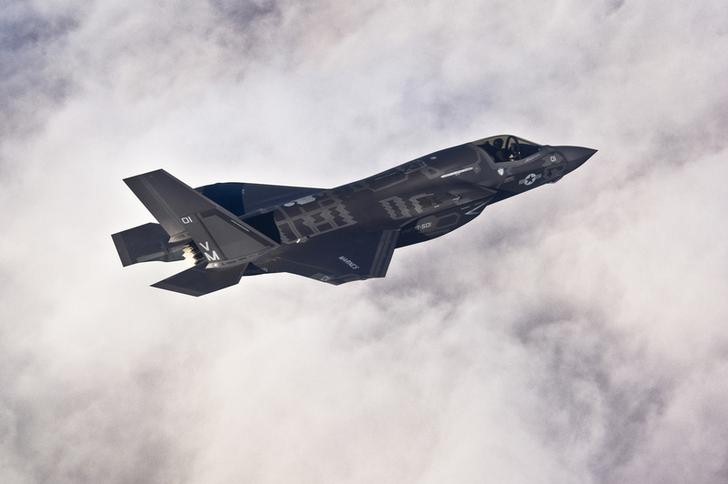
Lockheed Martin secured four U.S. defense contracts totaling approximately $137.6 million, led by a $70.1 million F-35 Romania-related modification and a $37 million submarine imaging support award. Additional contracts include $20.5 million for Virginia-class submarine spare parts and a $10 million THAAD modernization modification. The awards are constructive for backlog and reinforce steady demand, but the amounts are modest relative to Lockheed Martin's scale.
This reads more like backlog validation than a single-event catalyst: the mix of air, submarine, and missile-defense awards reinforces that LMT is monetizing a multi-year replenishment cycle, not just headline geopolitical tension. The second-order effect is that contract wins across disparate platforms reduce program concentration risk and support a higher-quality earnings multiple because they improve visibility into sustainment revenue, which tends to be stickier than new-build procurement.
The most interesting signal is the international F-35 support component. Foreign military sales are often underappreciated because they extend the economic life of the fleet through training, logistics, and software/maintenance spend; that implies a longer tail on margin-bearing services and a larger installed-base annuity. On the supply chain side, these awards likely keep niche aerospace electronics, castings, and precision-machining vendors tight for longer, but the real beneficiary is LMT's programmatic leverage: once sustainment ramps, revenue is less lumpy and less sensitive to near-term procurement timing.
The contrarian view is that investors may be overreacting to the headline dollar value without adjusting for the long-dated completion windows. Most of the cash conversion is stretched over years, so near-term EPS uplift should be modest unless this is part of a broader margin/working-capital improvement story. The risk is not cancellation so much as execution slippage, margin pressure on fixed-price work, or a policy pivot that slows procurement urgency after the current geopolitical premium fades over the next 3-6 months.
For competitors, the message is mixed: primes with similar backlog profiles should benefit from a read-through on Pentagon continuity, but names dependent on fresh award cadence rather than sustainment could lag if capital rotates toward higher-visibility incumbents. Subsea and missile-defense suppliers may see incremental demand, yet the bigger market implication is that defense spending is increasingly maintenance-heavy, which favors scale and hurts smaller platform pure-plays.
AI-powered research, real-time alerts, and portfolio analytics for institutional investors.
Request TrialOverall Sentiment
mildly positive
Sentiment Score
0.25
Ticker Sentiment
