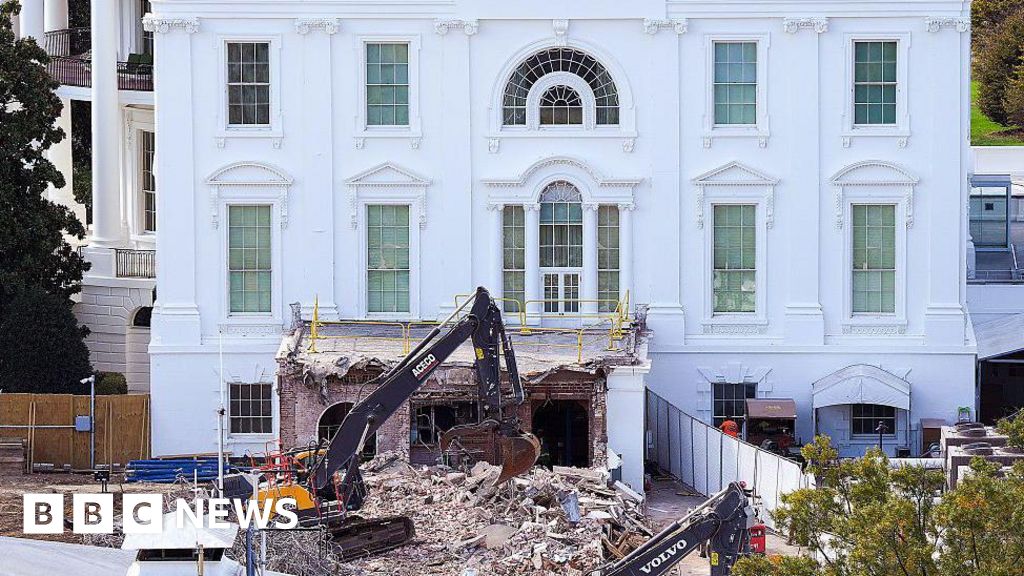
A US judge halted aboveground construction of Trump’s White House ballroom, ruling Congress must approve the project, while allowing underground bunker plans to continue. The White House has said the project is budgeted at $400M and privately funded, but the court dispute and appeal introduce delay and legal risk. The article also notes preliminary approval for a separate 250ft victory arch, with $15M in NEH funding earmarked in public spending plans.
This is less about a ballroom and more about a court-created governor on the administration’s ability to convert discretionary federal real estate into privately financed political theater. The immediate market read is that preservation, permitting, and constitutional-process litigation can still slow executive-driven capital projects even when funding is not the binding constraint, which raises the hurdle rate for any contractor, donor, or adjacent vendor expecting rapid award conversion. The bigger second-order effect is that the project’s “security” reframing may now be tested as a legal doctrine; if the appeal narrows that escape hatch, it could chill similar attempts to bypass normal review on other federal builds.
For contractors and specialty subcontractors, the risk is a timing mismatch: work can be paused aboveground while lower-site enabling work continues, creating scope fragmentation and change-order risk over the next 1-3 quarters. That usually favors the owner’s counsel and hurts firms with fixed-price exposure, especially if donor enthusiasm proves less elastic when headlines turn adversarial. The underground exemption is also a clue that the court is not anti-project, just anti-procedure, which means a negotiated redesign or re-application could still resurrect the aboveground phase if the administration is willing to slow-roll.
The contrarian angle is that the market may be underpricing the odds of partial completion and overpricing the probability of outright cancellation. In political-capital projects, legal delay often increases eventual spend because redesigns, compliance work, and security specifications become more expensive after interruption. Separately, the broader pattern of federally branded monuments and defense-adjacent construction suggests more public-private spend can be redirected into politically salient infrastructure, which could support niche engineering, security, and specialty materials demand even while headline litigation stays noisy.
AI-powered research, real-time alerts, and portfolio analytics for institutional investors.
Request DemoOverall Sentiment
mildly negative
Sentiment Score
-0.15
