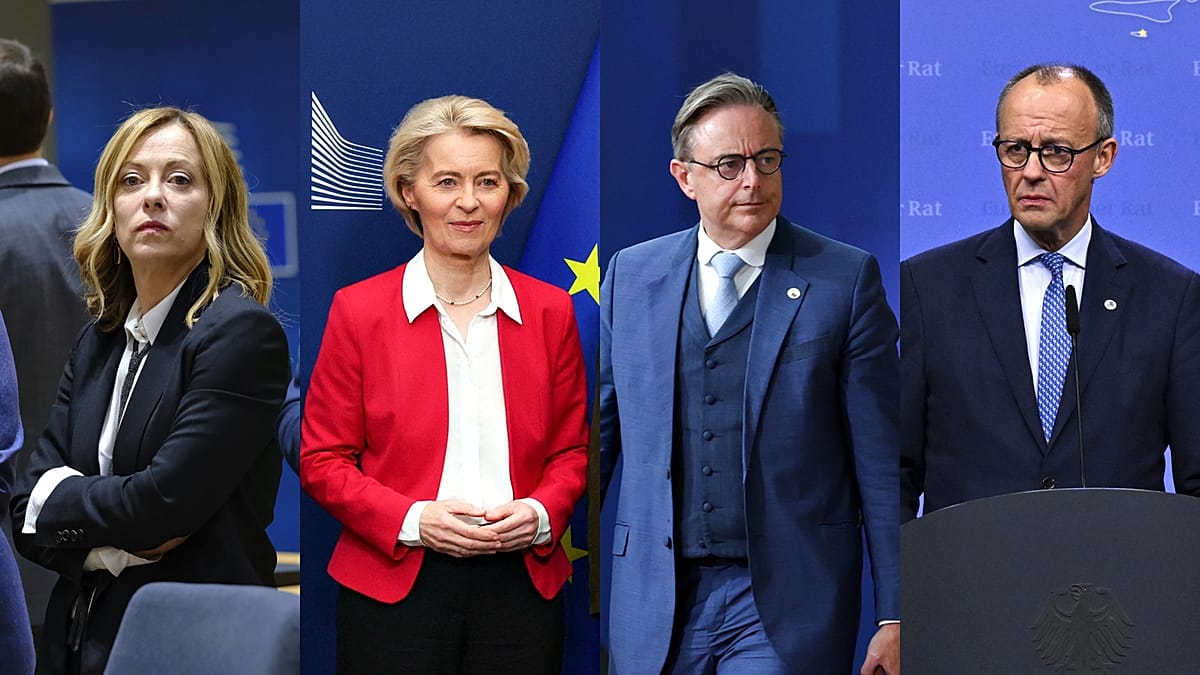
EU leaders are deadlocked over how to raise roughly €90 billion to fund Ukraine’s 2026–27 needs, weighing a novel Plan A — a zero‑interest “reparations” loan backed by immobilised Russian central‑bank assets (held since Feb. 2022) — against Plan B, joint borrowing; the reparations idea, championed by Commission president Ursula von der Leyen and German chancellor Friedrich Merz and backed by the Nordics, Poland, the Baltics, the Netherlands and others, would transfer custodial balances (Euroclear holds about €185bn; France reportedly has ~€18bn in private banks) to the Commission and ask Ukraine to repay only after Moscow ends the war and pays compensation. Opponents, led vocally by Belgium’s prime minister Bart De Wever (the chief custodian), Euroclear and a bloc including Italy, Bulgaria, Malta, the Czech Republic, Hungary and Slovakia, cite unprecedented legal, financial and retaliation risks and demand mutualised guarantees or safer, temporary bridges; France’s stance remains muted but decisive if it shifts. With unanimity unlikely, the Commission could move forward by qualified majority but faces political and legal headwinds and must produce interim financing by April to avert Ukrainian default, a deadline highlighted by President Zelensky as critical for Kyiv’s survival.
The EU faces a binding financing gap of roughly €90 billion to cover Ukraine's 2026–27 budget and military needs, and leaders are debating two options: Plan A, a zero‑interest "reparations" loan funded by immobilised Russian central‑bank assets seized since February 2022, and Plan B, joint borrowing by member states. Euroclear is cited as holding about €185 billion in Russian assets and France is reported to have ~€18 billion in private‑bank holdings; under Plan A those custodial balances would be transferred to the Commission and Kyiv would repay only after Moscow ends the war and compensates for damages.
The proposal is championed by Commission President Ursula von der Leyen, German Chancellor Friedrich Merz and a coalition of Nordics, Poland, the Baltics, the Netherlands, Spain and Portugal, while Belgium (the chief custodian) and Euroclear, plus Italy, Bulgaria, Malta, the Czech Republic, Hungary and Slovakia, oppose it on legal, financial and retaliation grounds. Belgium’s PM Bart De Wever conditions approval on full mutualisation of risks, effective liquidity guarantees and burden‑sharing, and Euroclear has warned the scheme is "very fragile" and legally experimental; Moscow has already sued Euroclear.
Politically a qualified‑majority could pass the reparations loan without unanimity, but France’s stance is pivotal and diplomats acknowledge approval without broad Belgian consent may be unsustainable; if neither plan advances the Commission must design interim financing because Ukraine needs fresh aid by April to avoid default. The situation creates near‑term legal and sovereign‑liquidity risk for custodians and raises event‑driven volatility for European sovereign and credit markets while the summit and subsequent legal text revisions play out.
AI-powered research, real-time alerts, and portfolio analytics for institutional investors.
Request DemoOverall Sentiment
mixed
Sentiment Score
0.00
