




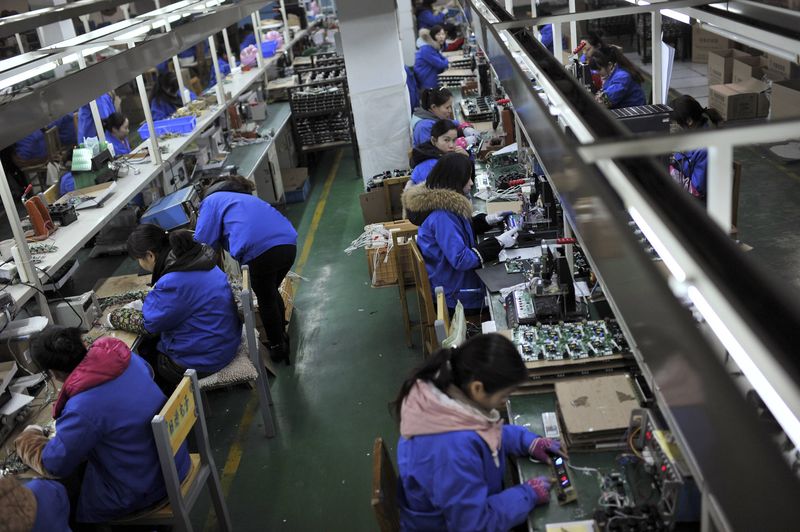
China’s official manufacturing PMI slipped to 50.0 in May from 50.3, signaling stalled factory growth, while the non-manufacturing PMI improved to 50.1 from 49.4 and returned to expansion. The data point to slowing momentum after a strong start to the year, even as Beijing has responded with policy easing, including a record-low one-year policy loan rate from the PBoC. Export resilience tied to AI-related demand remains a support, but stronger yuan pressure and softer domestic activity are headwinds.
The setup is less about “China softening” and more about a split economy: domestic cyclicals are decelerating while export-heavy hardware tied to AI infrastructure still has a late-cycle tailwind. That matters because it concentrates marginal growth in a narrow set of supply chains — chips, servers, power gear, and assembly — which can keep certain exporters strong even if broader Chinese activity stalls. The bigger second-order effect is that policy easing may not transmit cleanly into equity upside if credit demand stays weak and FX pressure persists.
For the listed names, the most important angle is that any AI-linked China manufacturing beneficiary is increasingly being priced as a quasi-global capex lever, not a China beta trade. That favors suppliers with pricing power and scarce product, while commoditized hardware assemblers remain vulnerable to margin compression if yuan strength and input-cost pressure continue. If Washington-Beijing trade friction cools even modestly, the market will likely re-rate the “AI export” complex faster than it will improve the domestic China basket.
The main risk to the bearish China macro read is a policy gap-filling response over the next 1-3 months: additional liquidity, targeted consumption support, or FX stabilization could stop the downgrade cycle before it turns into earnings cuts. But the contrarian point is that a weaker PMI at the threshold does not automatically imply outright contraction in equities; it can actually be bullish for select exporters if domestic stimulus sustains input demand while global AI capex remains intact. In other words, the trade is not “short China,” it is “long the narrow winners, short the broad cyclicals that need a clean domestic rebound.”
AI-powered research, real-time alerts, and portfolio analytics for institutional investors.
Overall Sentiment
mildly negative
Sentiment Score
-0.15
Ticker Sentiment
