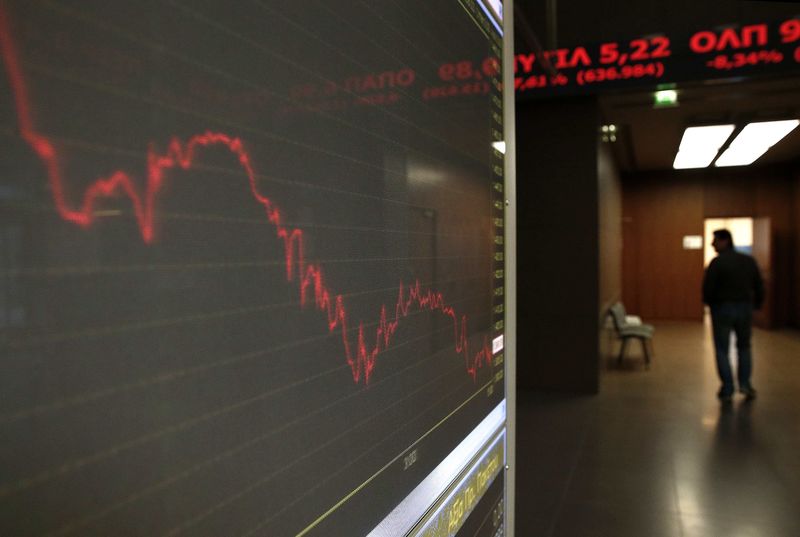
Greek stocks were essentially flat, with the Athens General Composite down just 0.01% as gainers narrowly outnumbered decliners 63 to 53. Standout movers included Athens Medical up 4.02% and Coca Cola HBC down 2.45%. Commodity moves were more pronounced, with June gold futures falling 1.72% to $4,745.89, while June Brent rose 0.95% to $96.39 and the US Dollar Index Futures added 0.17% to 98.07.
The tape reads less like a macro regime shift and more like a factor rotation inside a low-conviction market: defensives and foreign-exposed consumer names are being sold while locally sensitive healthcare, industrial, and infrastructure names are catching a bid. The key second-order signal is that energy is firming at the same time the euro is stable and gold is softening, which usually supports a near-term relative outperformance window for balance-sheet-heavy cyclicals and transportation-linked names versus import-dependent consumer staples.
The loser list suggests the market is still punishing companies with direct commodity pass-through or weaker pricing power. If oil holds near current levels for several sessions, expect margin compression to show up first in beverage, food, and packaging chains, then bleed into retail and tourism-related discretionary spend over the next 1-2 quarters. That matters because Greece’s market is thin: a few large names can drive index-level behavior well beyond the headline flat close.
The contrarian angle is that the market may be overpricing the durability of this micro-rotation. A one-day commodity pop is not enough to re-rate domestic cyclicals unless it coincides with better global growth data or a weaker dollar; otherwise, this is likely a mean-reversion trade rather than a trend. Gold’s decline also hints that real-rate or risk-premium positioning is not deteriorating, so any aggressive long-energy or short-consumer expression should be treated as tactical, not structural.
The most actionable setup is a relative-value basket: long domestic infrastructure/healthcare exposure and short branded consumer/food exposure for 2-6 weeks, betting on margin resilience and index rebalancing flows rather than outright beta. On the commodity side, a short-duration long crude/short EUR-sensitive consumer proxy works only if oil stays bid and EUR/USD remains rangebound; otherwise the trade’s edge decays quickly. The risk is a reversal in crude within days, which would squeeze the sector rotation and leave the defensive shorts vulnerable to a fast cover rally.
AI-powered research, real-time alerts, and portfolio analytics for institutional investors.
Request TrialOverall Sentiment
neutral
Sentiment Score
-0.05
