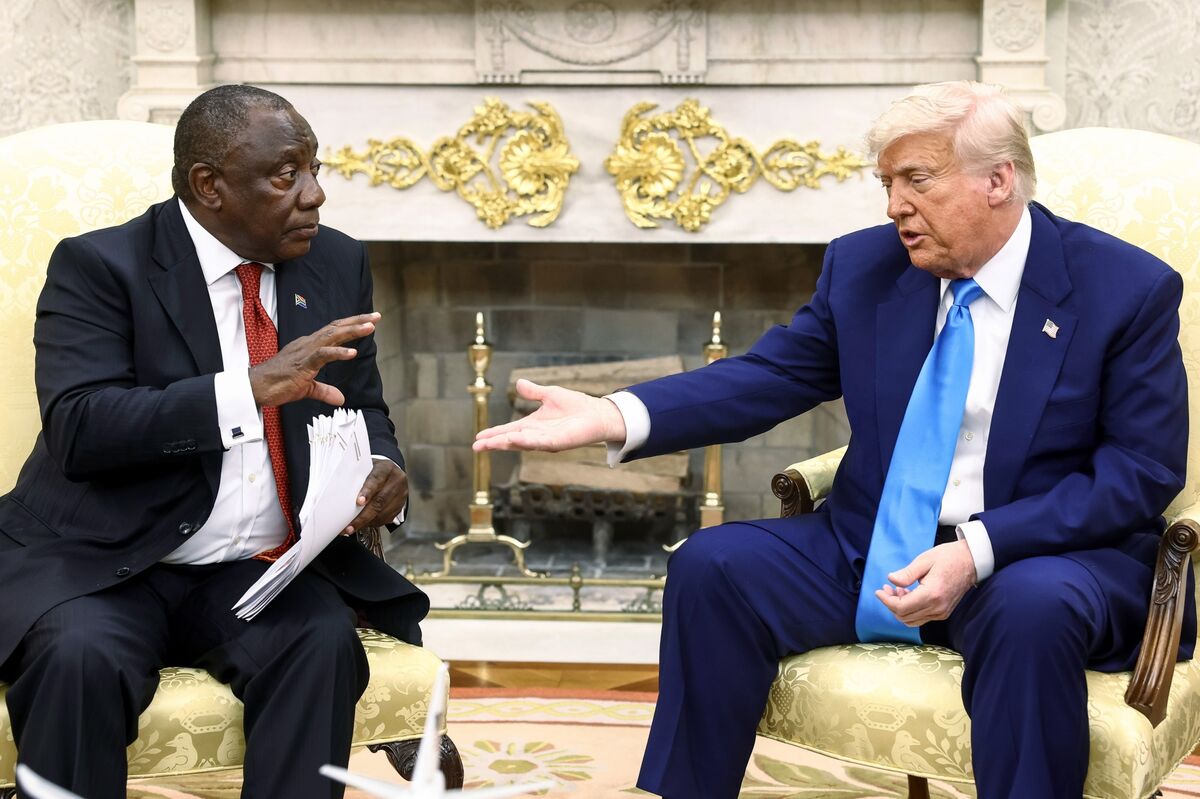
U.S. President Donald Trump said he would not invite South Africa to next year’s G-20 summit in Miami and intends to “stop all payments and subsidies” to Pretoria, escalating a deterioration in bilateral ties. His social-media post repeated unverified allegations of genocide against White Afrikaners and land seizures; the threats raise the prospect of reduced U.S. financial support and heightened political risk for South Africa, potentially affecting investor sentiment toward South African sovereign and emerging-market exposure.
Market structure: Short-term winners are safe-haven assets (USD, gold/precious-metal miners) and liquid US Treasuries; losers are South Africa-specific assets (EZA ETF, ZAR, SA sovereign bonds, SA banks) as political rhetoric raises country-risk premia. Mining firms with dollar-priced output (SBSW, GDX constituents) gain pricing power if ZAR weakens, but exporters face operational/FX repatriation risk; domestic financials face margin pressure and deposit flight. Cross-asset: expect ZAR depreciation, SA 10y spread widening vs USTs, EM FX vols spiking 4–8% intraday, and a 2–5% bid into GLD/GDX on a shallow risk-off move.
Risk assessment: Tail risks include targeted sanctions or US aid cuts (low probability but would widen SA CDS >150–250bps) and contagion into broader EM flows if rhetoric escalates into policy action within 30–90 days. Immediate (days): knee-jerk EM outflows; short-term (weeks–months): higher borrowing costs and equity drawdowns in SA; long-term (quarters–years): sustained political risk premium if diplomatic rupture persists. Hidden dependencies: miners’ USD revenues cushion FX hits but South African operations can face labour/political disruptions; commodity price swings can amplify outcomes. Catalysts: further public statements from US admin, G-20 invite formal decision (next 30–90 days), or coordinated international responses.
Trade implications: Direct plays favor long gold/miners (GDX, SBSW) and short SA exposure (EZA, ZAR) using liquid ETFs and FX options; prefer pair trades to neutralize commodity-price beta (long GDX, short EZA dollar-neutral). Options: buy 3-month EZA 8–12% OTM puts or USDZAR 3-month calls sized 0.5–1% notional to capture tail moves; use 12–20% stop-loss on directional ETF shorts. Sector rotation: reduce EM small-cap/financials by 2–5% of portfolio, redeploy into commodities and cash; enter within 1–7 trading days of volatility spike, trim at 25–40% P&L or after 90 days.
Contrarian angles: Consensus overstates permanence of rhetoric—full sanctions are unlikely, so deep drawdowns (>15–20% in EZA or >10% ZAR move) may create asymmetric buying opportunities in miners and select SA exporters. Historical parallels (short-lived EM selloffs tied to political statements) show 6–12 month mean reversion; crowding in short-EZA could produce sharp snapbacks if rhetoric cools. Unintended risk: aggressive short positioning can be gamma-negative—use option-based hedges or size limits to avoid forced covering on rebound.
AI-powered research, real-time alerts, and portfolio analytics for institutional investors.
Request DemoOverall Sentiment
moderately negative
Sentiment Score
-0.35
