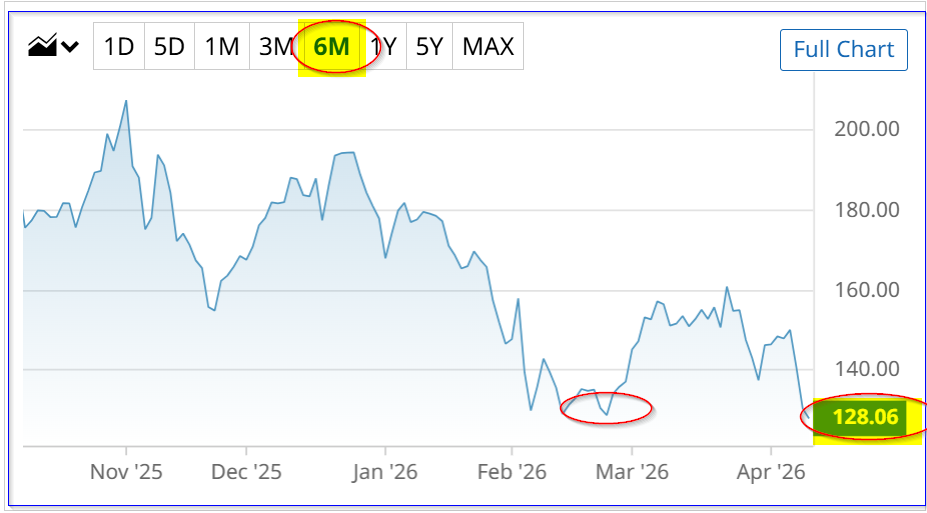
Palantir fell to a new 6-month low at $128.06, but the article argues the stock is undervalued based on strong free cash flow and improving analyst revenue estimates. The piece highlights a modeled 2026/NTM adjusted FCF of about $5.0B versus $2.27B in 2025, implying a potential fair value around $211 per share, or roughly 65% above the current market cap basis used in the article. It also notes attractive put-selling setups for May 15, with the $115 strike yielding 4.39% and the $110 strike yielding 3.35% over one month.
The setup is less about “cheap” and more about convexity around a crowded growth winner. When a high-multiple software name makes a new intermediate-term low into earnings, the first-order move is often not a clean valuation re-rate; it is dealer and systematic flow amplification as short-dated options reprice and momentum funds reduce exposure. That creates an opportunity for patient capital, but the better entry is usually after implied volatility expands further into the report, not on the first technical break.
The deeper point the market may be missing is that PLTR’s fundamental story is increasingly self-financing, which reduces the odds of a permanent de-rating unless growth decelerates materially. If forward cash generation keeps compounding faster than revenue, the equity can support a higher terminal multiple even if sentiment cools, because the business begins to look less like a “story stock” and more like a cash compounder with software-like operating leverage. That said, the market can still punish any sign that government growth is lumpy or that commercial expansion slows, because the current valuation embeds near-perfect execution.
For competitors and adjacent beneficiaries, the key second-order effect is not direct share capture but capital allocation pressure across the AI software complex. A sustained rerate in PLTR would pull multiple premium back into other profitable AI infrastructure and analytics names; a failed rebound would likely compress the group and reward lower-beta enterprise software instead. The contrarian risk is that investors may be overconfident in back-solving valuation from cash flow while underestimating the duration of sentiment-driven multiple compression if earnings merely meet, rather than beat, the elevated bar.
The cleanest trade expression is not an outright chase. Selling downside skew via puts is attractive only if sized as a willingness-to-own trade, because the event risk into earnings can cheaply turn a premium harvest into long stock at a still-rich basis. If the name bounces into the report, the better risk/reward may be to monetize upside via calls or call spreads rather than chase common; if it weakens further, a staged put-sale ladder lowers entry while preserving positive carry.
AI-powered research, real-time alerts, and portfolio analytics for institutional investors.
Request DemoOverall Sentiment
mildly positive
Sentiment Score
0.20
Ticker Sentiment
