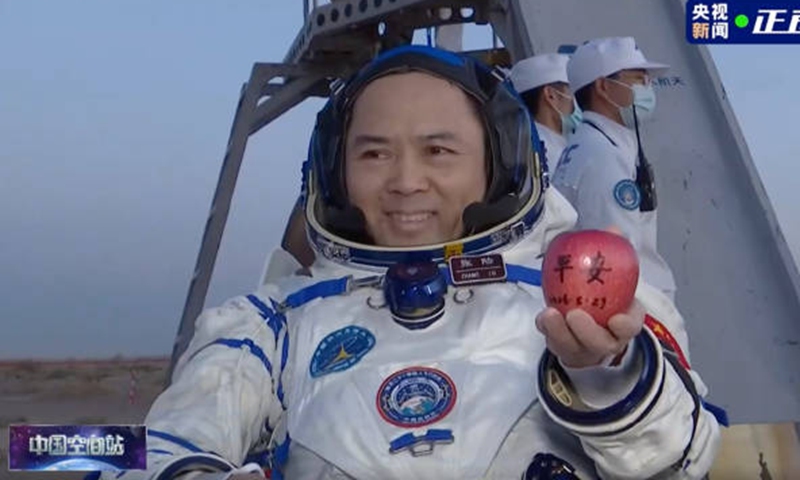
China's Shenzhou-21 crew completed a historic 210-day orbital mission and returned safely to Earth aboard Shenzhou-22, with the return capsule landing accurately at 20:11 and all three taikonauts reported in good condition. The mission set a new Chinese record for longest single crewed spaceflight and marked several firsts, including the country's second three-orbit fast return and the first crew return aboard a different spacecraft. The article is primarily a successful mission update with limited direct market impact.
The key investment signal is not the successful landing itself, but the proof that China has moved crewed-space operations from heroic one-off missions toward a resilient, redundant system. That matters because redundancy lowers the probability-weighted cost of failure across the whole manned-space stack: launch cadence can rise, insurance/contingency costs should compress, and contractors with mature guidance, docking, thermal, and reentry subsystems should gain share as procurement shifts from capability demonstration to reliability and turnaround speed.
Second-order beneficiaries are likely in the industrial and defense-adjacent ecosystem rather than the headline space operators. The successful emergency swap of crew return vehicles validates an operational doctrine that requires more spare vehicles, more on-orbit consumables, more rapid refurbishment, and more ground-support logistics; over 6-18 months that should support incremental demand for specialized materials, avionics, precision manufacturing, and mission-support services. The underappreciated loser is any supplier reliant on single-point mission success premiums — as operational maturity rises, pricing power migrates from “space firsts” to “space uptime.”
The near-term contrarian risk is that the market overestimates commercial spillover. A technically impressive crew return does not automatically translate into a step-function in space commercialization; monetization will still be gated by payload economics, launch pricing, and policy allocation. If there is no follow-on acceleration in mission frequency or budget growth within the next 2-3 quarters, the thematic trade could fade into a narrative-only bid.
The cleaner trade is to express confidence in China’s space-industrial supply chain rather than chase the front-end event. The best setup is a relative-value long in high-reliability aerospace/defense manufacturers versus broader China cyclicals, with the thesis that mission assurance spending is less cyclical and more sticky than general industrial capex. The risk is policy-driven headline volatility; any sign of reduced launch cadence, delayed station expansion, or a pause after this emergency cycle would cap upside quickly.
AI-powered research, real-time alerts, and portfolio analytics for institutional investors.
Request DemoOverall Sentiment
mildly positive
Sentiment Score
0.20
Ticker Sentiment
