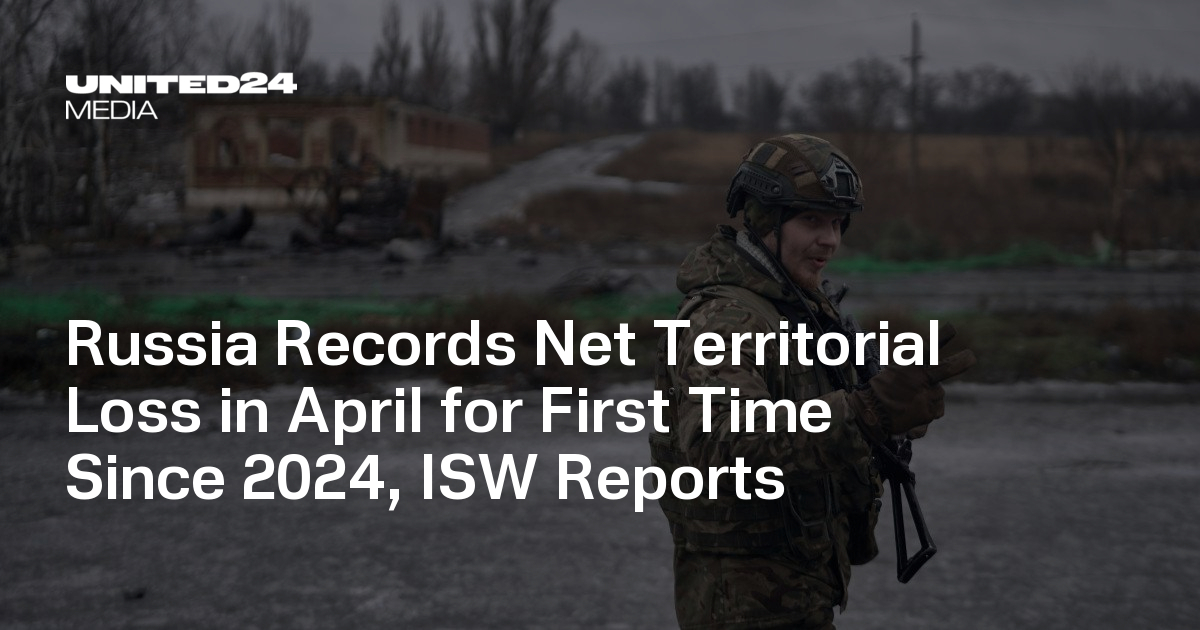
Russia recorded a net territorial loss of 116 square kilometers in April 2026, its first monthly setback since August 2024, as offensive momentum has slowed since November 2025. ISW attributes the deterioration to Ukrainian counterattacks, strikes on logistics and command nodes, disrupted communications, and poor mud-season mobility. Russian gains also fell sharply, with advances averaging 2.9 square kilometers per day in early 2026 versus 9.76 square kilometers per day in early 2025.
The key market implication is not the territorial print itself, but the evidence that Russia’s cost curve for incremental gains is steepening while the quality of those gains is deteriorating. That usually precedes a shift from maneuver warfare toward attritional standoff, which favors the side with deeper strike capacity, better ISR, and tighter logistics disruption over the side with more mass. In practice, this raises the relative value of missile defense, counter-UAS, EW, and munitions supply chains versus platforms optimized for large-scale offensive mobility.
A second-order effect is timing: seasonal terrain constraints can temporarily suppress offensive tempo for weeks, but they do not solve the underlying coordination problem. If Russian communications remain degraded into summer, the larger risk is not a dramatic collapse, but a grindier campaign that burns ammunition and vehicles faster than territory changes hands. That is constructive for western defense demand over a 6-12 month horizon, especially systems tied to precision strike, battlefield networking, and air defense replenishment.
The contrarian read is that markets may underappreciate how much of this is already priced into defense equities after a long rerating. The better trade may be within the complex rather than outright beta: suppliers with ammunition backlogs and near-term capacity expansion should outperform prime contractors reliant on long-cycle programs. The main reversal catalyst is a political inflection rather than battlefield improvement—any credible ceasefire or aid fatigue narrative could compress defense multiples quickly, even if the military balance remains unfavorable for Russia.
AI-powered research, real-time alerts, and portfolio analytics for institutional investors.
Request DemoOverall Sentiment
mildly negative
Sentiment Score
-0.35
