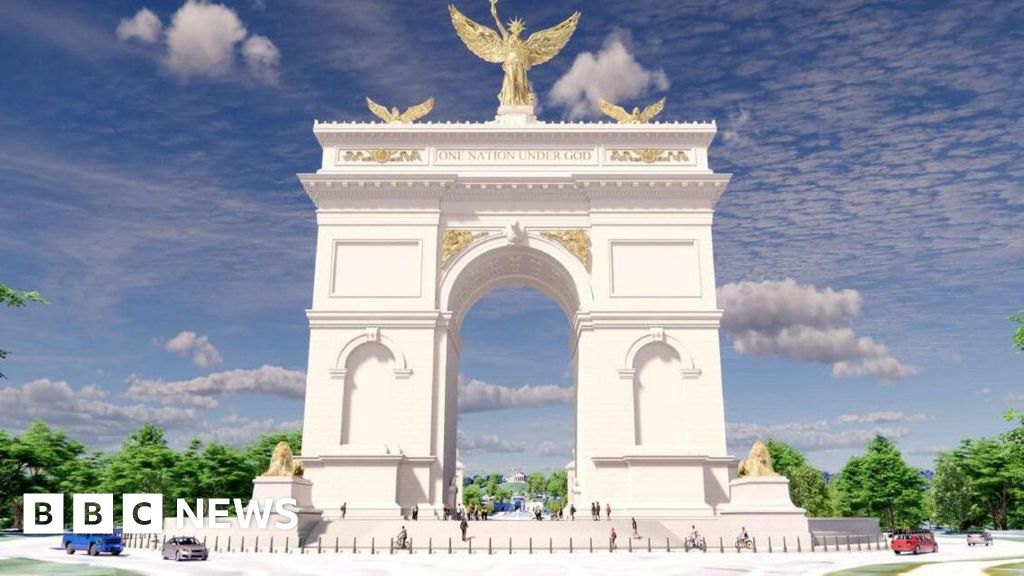
The White House has unveiled a proposed 250ft gold-accented victory arch for Washington, DC, with $2m in NEH special funds and $13m in matching funds designated in a public spending plan. The project faces legal and review hurdles, including Commission of Fine Arts scrutiny and similar challenges to Trump’s ballroom plan, while historic preservation groups have already sued over related changes. The article is primarily a political and civic-design story with limited direct market impact.
This is not a direct market catalyst so much as a signal about how federal discretionary spending is being repurposed toward symbolic capital projects. The second-order implication is marginally supportive for firms exposed to government design, planning, ceremonial construction, and premium stone/metal fabrication, but the dollar amounts are too small to matter at the index level. The real market-relevant issue is precedent: once a project is politically framed as patriotic infrastructure, it can attract multiple funding channels and faster permitting scrutiny than a normal civic build.
The bigger winners are not the headline contractors, but the legal, lobbying, and specialty materials ecosystem around federal monument projects. If this advances, expect incremental demand for architecture/engineering firms with public-sector relationships, high-end fabrication shops, and regional security/logistics providers near DC. On the negative side, preservation-oriented legal challenges could extend timelines by 6-18 months, which raises bid costs and favors larger incumbents with balance-sheet capacity over smaller niche firms.
The contrarian point is that the market may overestimate the durability of these projects as catalysts. These are politically sticky but economically shallow: they create short bursts of spend, not recurring revenue, and can be reversed by injunctions, appropriations fights, or a post-election shift in the Commission/agency posture. Any public contractor exposure should be treated as a tactical trade around permit milestones rather than a structural theme.
From a portfolio standpoint, the better expression is a relative-value trade into beneficiaries of federal capital allocation uncertainty rather than outright longs on monument headlines. If similar projects proliferate, the hidden cost is that design-review bottlenecks and litigation slow unrelated DC-area construction, which can pressure schedules for real estate and public-works contractors in the region.
AI-powered research, real-time alerts, and portfolio analytics for institutional investors.
Request DemoOverall Sentiment
neutral
Sentiment Score
-0.05
