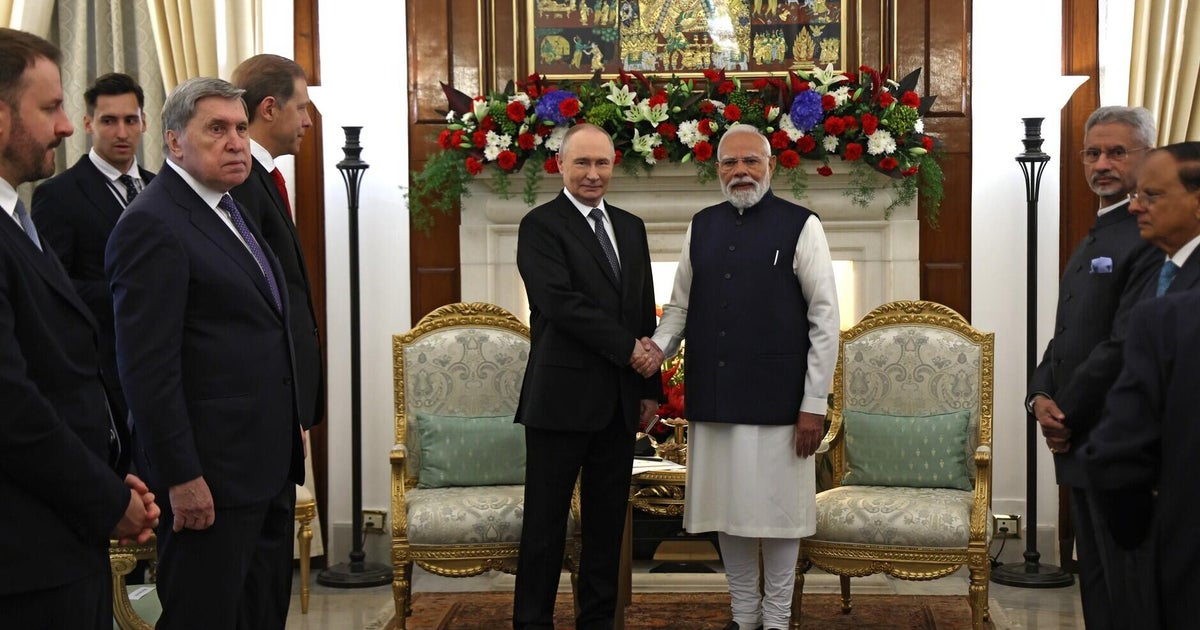
President Vladimir Putin and Prime Minister Narendra Modi agreed a Russian-Indian economic cooperation program aimed at boosting annual bilateral trade from $68.7 billion (last fiscal year) to $100 billion by 2030, advanced talks on an India–Eurasian Economic Union free-trade arrangement, and pledged continued and “uninterrupted” Russian fuel supplies. The leaders also deepened defence and energy ties (including pending S-400 deliveries from a 2018 ~$5.4 billion deal) even as U.S. sanctions on Russian oil producers and a U.S. tariff posture (including a cited 50% tariff on some Indian goods) complicate India’s negotiations with the U.S. and EU, underscoring elevated geopolitical and supply-chain risks for energy, fertilizers and defence-related flows.
Market Structure: Putin’s India visit signals a durable reorientation of Russian energy flows toward India/Asia, likely cementing discounted long-term crude contracts and larger volumes of seaborne barrels to South Asia. Winners: Indian refiners/marketing majors (Reliance, BPCL, IOC) that can capture cheap feedstock and tankers that carry sanctioned cargoes; losers: Indian exporters to US/EU if tariffs stay (trade flow diversion) and Western suppliers losing market share. Expect wider Urals-Brent discounts (200–400¢/bbl vs Brent) rather than a shock to Brent, and persistent freight-rate volatility but higher time-charter utilization for midsized product/time-charter tankers over 6–12 months.
Risk Assessment: Tail risks include US secondary sanctions or 50% tariffs expanding (high impact, <30% probability) which could trigger abrupt trade stoppages and stranded tankers; operational risks include seizure/insurance denial for sanctioned cargoes. Near-term (days–weeks) volatility around policy statements; medium-term (3–12 months) contractual re-routing and discount normalization; long-term (2–5 years) structural India-Russia trade integration via EAEU FTA. Hidden dependency: insurance and SWIFT/transaction rails — a cut there would materially reduce volume despite political agreements.
Trade Implications: Direct plays: go long tanker names with careful compliance filters (STNG, DHT) via 3% position sizes for 6–12 months to capture higher TC rates and contango; long Indian refiners (RELIANCE.NS, IOC.NS, BPCL.NS) 2–4% to monetize lower input cost over 12–24 months. Hedge: buy 3-month puts on India ETF INDA (10–15% OTM) sized to offset export risk if US tariffs remain >25% or expand; consider long NTR (Nutrien) or YAR.OL 2% to play fertilizer supply contracts from Russia.
Contrarian Angles: Consensus assumes sanctions will choke flows — underdone is the operational adaptability: long-term contracts, insurance workarounds, and discounts will keep volumes moving, pressuring refined product margins globally. Reaction may be overdone in India-export volatility; a tactical pair (long RIL, short INDA) captures domestic industrial upside vs export tariff risk. Monitor three catalysts: US tariff announcements (next 30–90 days), Russian-India FTA milestones (next 6–12 months), and insurance/Banking de-risking moves — any one can flip trades within weeks.
AI-powered research, real-time alerts, and portfolio analytics for institutional investors.
Request DemoOverall Sentiment
mixed
Sentiment Score
0.05
