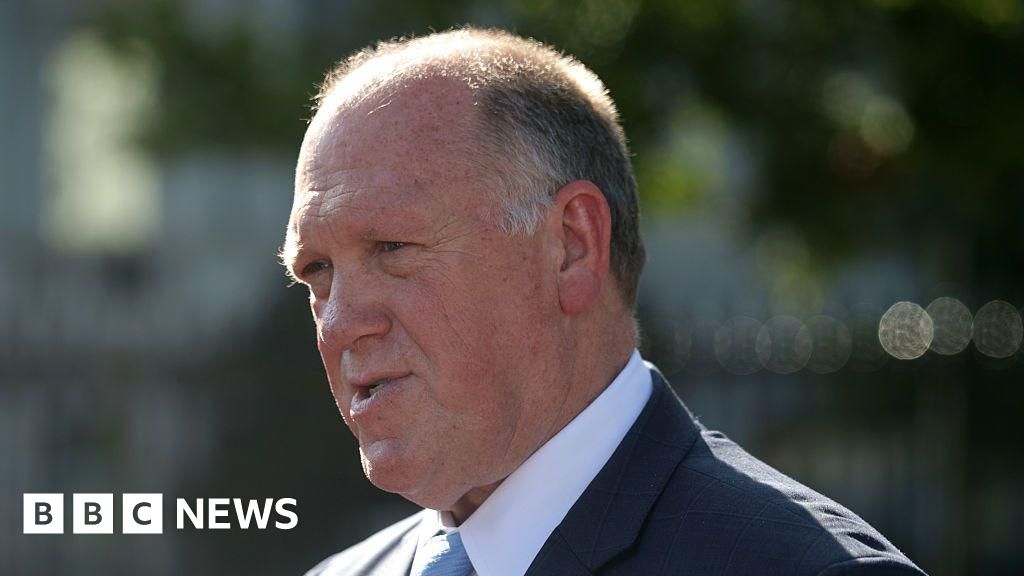
President Trump has deployed Tom Homan as his on-the-ground 'border tsar' in Minneapolis following two fatal shootings involving federal agents, replacing Border Patrol figure Gregory Bovino. Homan, a long-time immigration enforcer and vocal defender of aggressive deportation policies (and previously head of ICE Enforcement and Removal Operations), is a political appointee without Senate confirmation whose arrival signals a continuity of hardline interior-enforcement priorities rather than a strategic shift. For investors, the story primarily constitutes political and operational risk — potential for heightened local unrest, legal scrutiny and headline volatility — but it is unlikely to materially alter macro or sectoral financial fundamentals.
Market structure: The replacement of a tactical Border Patrol commander with a seasoned ICE veteran signals continued federal emphasis on interior enforcement rather than de-escalation — direct beneficiaries are government IT/analytics and defense contractors that service DHS (e.g., PLTR, LDOS, CACI) and, secondarily, detention operators (GEO, CXW). Expect incremental DHS operational spend on interior enforcement of the order of several hundred million to low‑single‑digit billions over 6–12 months as field deployments and task forces are formalized.
Risk assessment: Tail risks include large-scale civil unrest or successful nationwide injunctions that could curtail detention/enforcement (low probability, high impact) and ESG-driven divestment/contract cancellation hitting GEO/CXW within 3–18 months. Immediate (days) volatility will be driven by headlines; medium term (3–12 months) by contract awards and DHS budget language; long term (12–36 months) by litigation and elections.
Trade implications: Favor small, tactical long exposure to gov‑tech contractors able to capture task‑order work (PLTR, LDOS) sized 1–2% position each, using 3–9 month call spreads to limit downside; avoid concentrated bets on detention operators or hedge them due to litigation/ESG risk. Cross‑asset: short-duration muni exposure for Minneapolis/ Hennepin County may see spreads widen 25–75bp if political risk escalates; USD/t-bills likely neutral to slightly stronger on law-and-order policy clarity.
Contrarian angles: Consensus stresses enforcement = wins for detention operators; overlooked is procurement timing and legal risk — post‑9/11 precedent shows an initial procurement spike followed by multi‑year plateau. If within 60 days DHS contract awards disproportionately favor analytics (PLTR/LDOS) over bricks‑and‑mortar operators, re‑rate allocations accordingly.
AI-powered research, real-time alerts, and portfolio analytics for institutional investors.
Request DemoOverall Sentiment
neutral
Sentiment Score
-0.15
