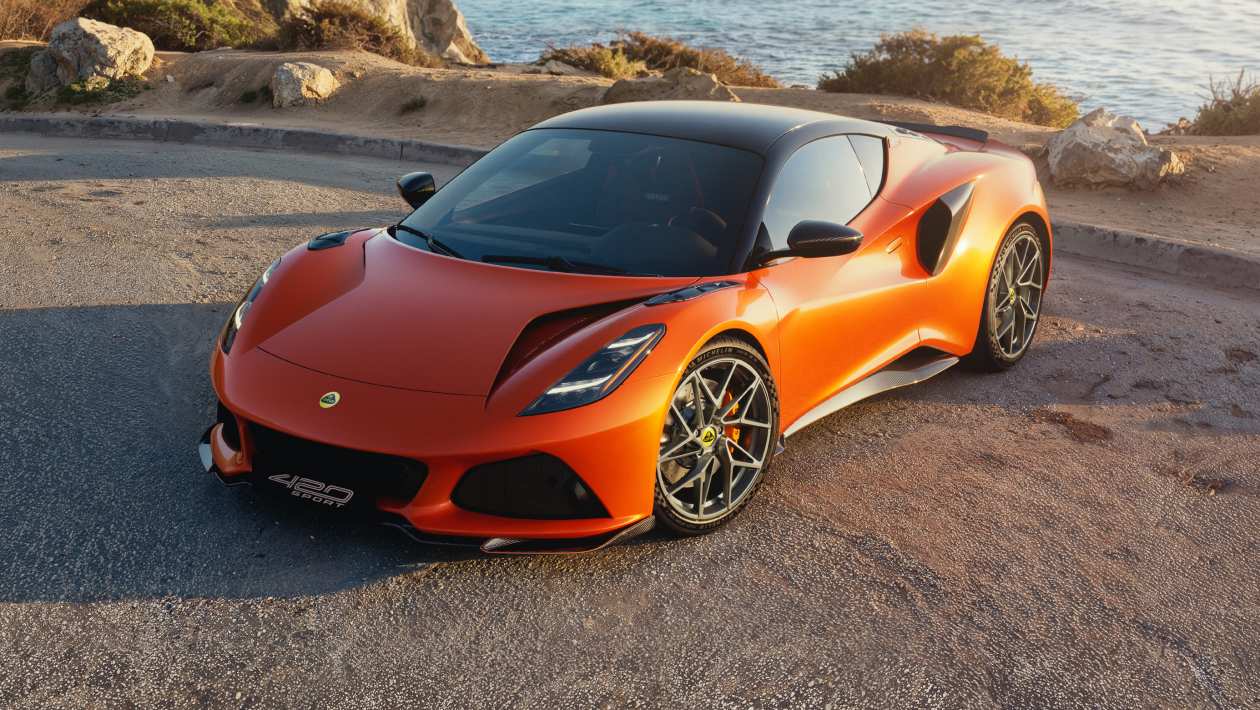
Lotus unveiled the £105,900 Emira 420 Sport, its lightest and most powerful Emira to date, with output raised to 420bhp from 400bhp and 0-60mph improved to 3.9 seconds. The model adds chassis, aero and weight-saving upgrades, including a Lightweight Handling Pack that brings curb weight down to 1,430kg, 25kg less than the Turbo SE. Lotus also signaled the next Emira will move to a hybrid powertrain, with more than 500bhp expected.
This is less a single-model refresh than evidence Lotus is still optimizing for a very specific, high-margin enthusiast niche: the customer who values track credibility over daily usability and is willing to pay for lightweight hardware and perceived exclusivity. The second-order implication is that Lotus is trying to defend price realization while de-risking the brand from pure EV timing uncertainty; higher-spec ICE halo products can support mix and keep the dealership funnel warm until the next powertrain arrives.
The competitive read-through is more interesting than the car itself. Porsche and Alpine are implicitly being challenged at the exact point where their halo models pull disproportionate attention and pricing power into their broader ranges. If this variant gets traction, the real beneficiary is likely the supplier ecosystem around performance damping, carbon fiber, and lightweight components rather than a volume OEM effect; those content-rich options matter because they raise BOM value without requiring mass-market units.
Near term, the catalyst is mostly ordering momentum and media-driven demand, not material P&L inflection. The risk is that this remains a narrow halo with limited production, meaning the headline optimism may overstate earnings impact; at the same time, any delay or dilution in the future hybrid roadmap would quickly compress the strategic narrative. Over a 6-18 month horizon, the stock-equity implication for listed peers is more about validating that premium ICE/track products can still command attention in a market assuming a straight-line EV transition.
The contrarian view is that the move may be underpowered if investors think this simply cannibalizes existing Emira trims rather than expanding the addressable pool. If the package mix shifts toward high-content, low-volume derivatives, the economics can improve even with flat unit volumes, but only if residual values and brand heat hold up. That makes the setup more durable as a positioning story than as a near-term earnings story.
AI-powered research, real-time alerts, and portfolio analytics for institutional investors.
Request DemoOverall Sentiment
moderately positive
Sentiment Score
0.35
