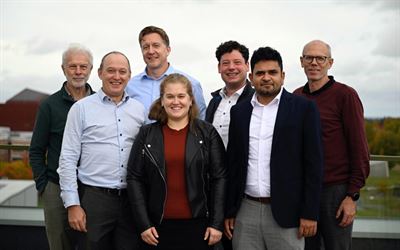
Polar Light Technologies secured a >€5 million financing round led by J2L Holding AB (with participation from STOAF, Almi Invest and Butterfly Ventures), taking total funding to €13 million to accelerate commercialization of its pyramidal MicroLED platform. The capital will fund rollout of initial products—targeting small HUD displays first, then smart glasses and wearables—building on public prototypes shown in 2025; the company’s single‑epi‑wafer full‑RGB architecture aims to lower production complexity and could pose a competitive threat to incumbent display technologies and suppliers.
Market structure: Polar Light’s €5m bridge to €13m total funding points to commercialization-first adoption in high-margin micro-HUDs, wearables and smart glasses where size-brightness-power matter — winners are niche foundries, MOCVD/equipment suppliers and AR OEMs that integrate MicroLED (Aixtron AIXA.DE, Veeco VECO, Apple AAPL). Incumbent OLED/LCD suppliers (LG Display LPL, some BOE segments) face displacement risk over 2–5 years in small-form factors; pricing power erosion is gradual, not immediate, because mass-transfer and yield scaling remain bottlenecks. Risk assessment: Tail risks include failure to scale yields, IP litigation, or a funding shortfall forcing dilution — each could wipe out equity in 12–24 months. Near-term (days-weeks) market impact is negligible for public equities; medium-term (3–12 months) hinges on design wins/partnerships; long-term (2–5 years) could materially reallocate capex from OLED to MicroLED. Hidden dependencies: reliable GaN/III‑V supply, mass-transfer tools, driver-IC ecosystem and OEM qualification cycles. Trade implications: Favor selective long exposure to semicap/MOCVD makers (AIXA.DE, VECO) and AR/AR-capable OEM optionality (AAPL, META) via calls/LEAPS timed 9–18 months out; trim pure-play OLED supply-chain exposure (LPL) by 1–3% of portfolio. Use relative-value: long AIXA, short LPL to capture technology-rotation risk; consider 6–12 month call spreads to cap capital while keeping upside tied to confirmed design wins. Contrarian angles: Market underestimates execution friction — full RGB single-wafer claims reduce one hurdle but do not solve mass-transfer and yield at scale, so adoption likely concentrated and slow (expect <5% share of wrist/headset displays by 2027). The market may be underpricing upside in MOCVD equipment makers if Polar Light’s approach proves replicable; conversely, it may be overpricing near-term disruption to large OLED makers. Watch for consolidation among smaller LED fabs as a noisy signal.
AI-powered research, real-time alerts, and portfolio analytics for institutional investors.
Request DemoOverall Sentiment
moderately positive
Sentiment Score
0.45
