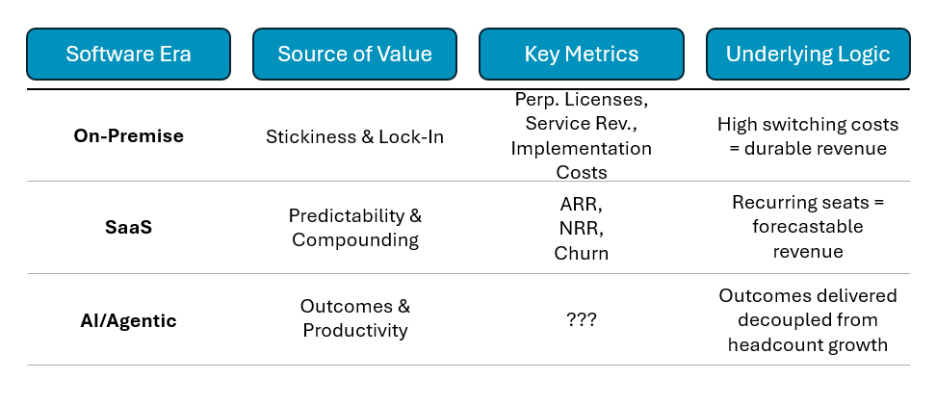
Nasdaq-100 companies are increasingly discussing AI on earnings calls (nearly 4 out of 5 constituents vs 1 in 5 pre-ChatGPT), shifting investor focus from seats/ARR toward AI-driven value metrics tied to work performed and customer productivity. The article cites expanding experimentation with consumption-based pricing (85% of surveyed SaaS companies) and highlights new disclosures—e.g., Salesforce’s Agentic Work Unit (AWU), ServiceNow’s 80%-85% agent automation for service requests, Intuit’s 12 hours/month and ~17 hours/week time savings, and Nasdaq’s up to 50% reduction in due-diligence monitoring time and >80% reduction in human alert review workload. Market-wide measurement has not converged, making cross-firm comparability difficult and increasing uncertainty around which metrics best signal durable, economically meaningful revenue.
The market is likely to reward software vendors that can prove AI drives measurable workflow completion, not just usage. That favors workflow-control names like NOW and CRM, and verticalized productivity platforms like INTU, because their AI can be tied to renewal, seat expansion, and pricing power rather than a vague “AI mention” premium. By contrast, infrastructure/consumption names such as SNOW, DDOG, and CFLT are at risk of having their usage metrics treated as inputs rather than durable monetization, which can compress multiples if investors decide token/API growth is not the same as economic value.
Near term, the key risk is that companies over-report vanity activity while gross margin tells the real story. If AI adoption increases inference or cloud pass-through costs faster than customers accept outcome-based pricing, the market will punish “AI engagement” narratives even when top-line growth looks fine. The 1-3 month catalyst path is earnings commentary on attach rates, retention, and any evidence that AI features are lifting ARPU; the 6-18 month structural effect is a reset in software valuation frameworks toward unit economics per workflow, not per user.
Contrarian view: the consensus may be underestimating how sticky outcome-based pricing can be once customers see hard labor substitution, especially in finance, compliance, and admin workflows. But it is also likely overestimating the durability of reported usage metrics that do not convert into contract value. The thesis is falsified if AI disclosures start to show higher renewal rates and clear margin-neutral monetization across multiple quarters rather than experimental usage spikes.
AI-powered research, real-time alerts, and portfolio analytics for institutional investors.
Request DemoOverall Sentiment
neutral
Sentiment Score
0.05
Ticker Sentiment
