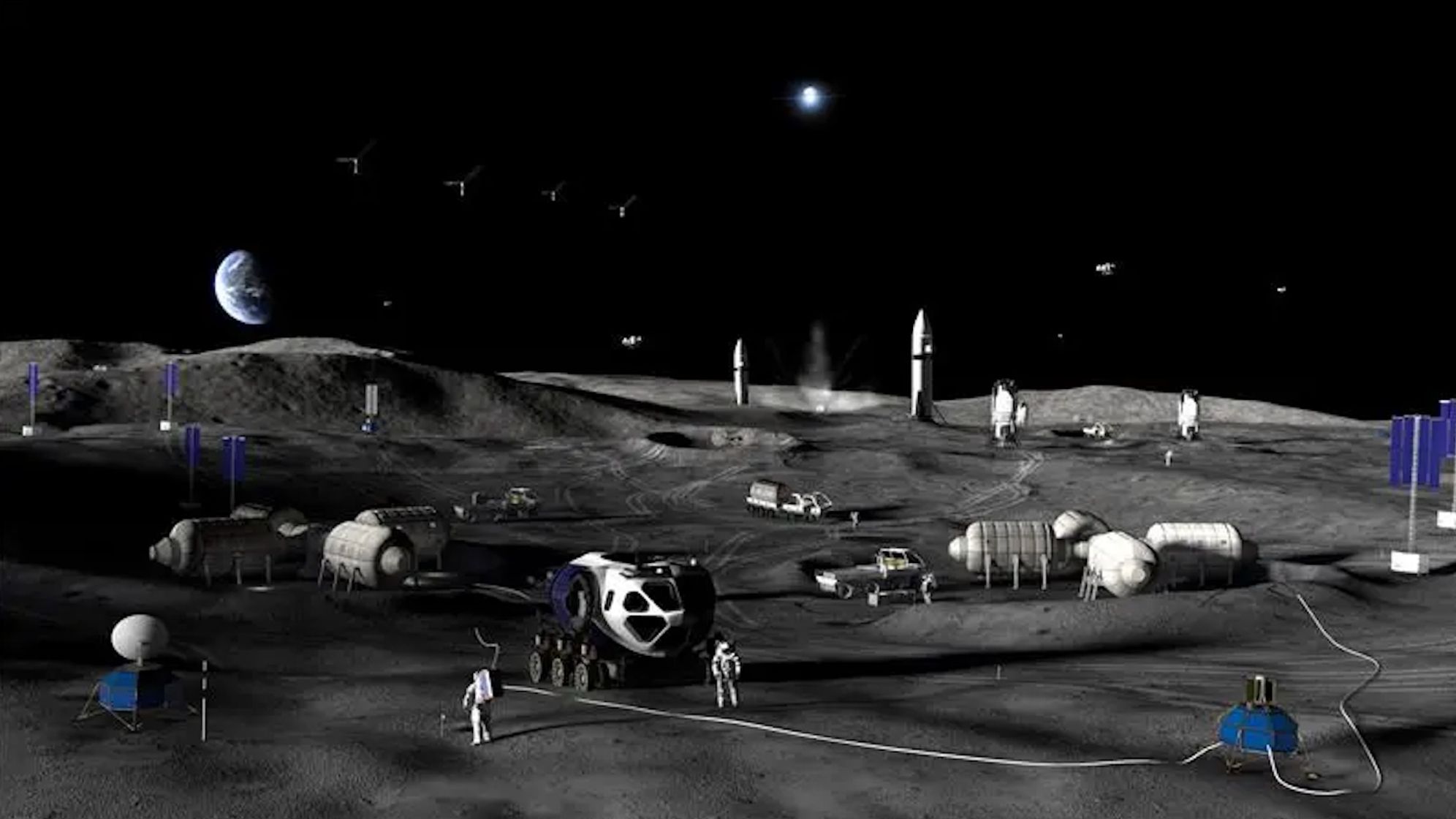
NASA will provide an update on May 26 on its Artemis moon base plans, including progress toward a sustained lunar presence, new industry partners, and mission plans. The agency says the surface base remains a core part of Artemis, while Gateway work has been paused and Artemis 3 will now focus on docking tests rather than a lunar landing. The first crewed lunar landing in the revised plan is Artemis 4, targeted for late 2028, with the moon base planned near the south pole between 2032 and 2036.
The update is less about lunar exploration optics and more about budget reallocation inside a constrained federal space stack. Moving emphasis from cislunar infrastructure toward a surface base increases the odds that near-term dollars flow to landers, habitats, power systems, comms, thermal management, and surface mobility rather than deep-space gateway components — a shift that tends to favor systems integrators and subsurface/remote infrastructure vendors over pure launch names. The market should also watch for procurement concentration: if NASA frames “new industry partners,” that can broaden the prize pool but usually compresses margins as competition shifts from technical differentiation to cost-plus discipline.
The key second-order effect is schedule risk. Artemis 4 and the 2032-2036 base window are long-dated, but the first-order catalyst is the next 6-12 months of contract awards and architecture choices. Any move that reduces dependence on Gateway lowers one integration layer, but it raises execution risk on the lunar surface where power, dust mitigation, and cryogenic operations are harder and less forgiving; that usually creates incremental demand for heritage defense contractors with spacecraft, avionics, ECLSS, and autonomous systems exposure. Conversely, companies relying on a large Gateway build-out or on a single lander pathway could see relative underperformance if NASA keeps pushing a multi-lander, surface-first strategy.
The contrarian view is that the biggest beneficiaries may be the “boring” infrastructure names, not the headline space pure plays. Investors tend to overestimate how much beta is left in moon narratives and underestimate how much of the spend is actually civil infrastructure, mission assurance, communications, and integrated logistics. If the update confirms a broader partner set, the trade may become less about breakthrough science and more about who can deliver on schedule with acceptable cost, which favors primes and select industrials over high-multiple space beneficiaries.
AI-powered research, real-time alerts, and portfolio analytics for institutional investors.
Request DemoOverall Sentiment
neutral
Sentiment Score
0.10
Ticker Sentiment
