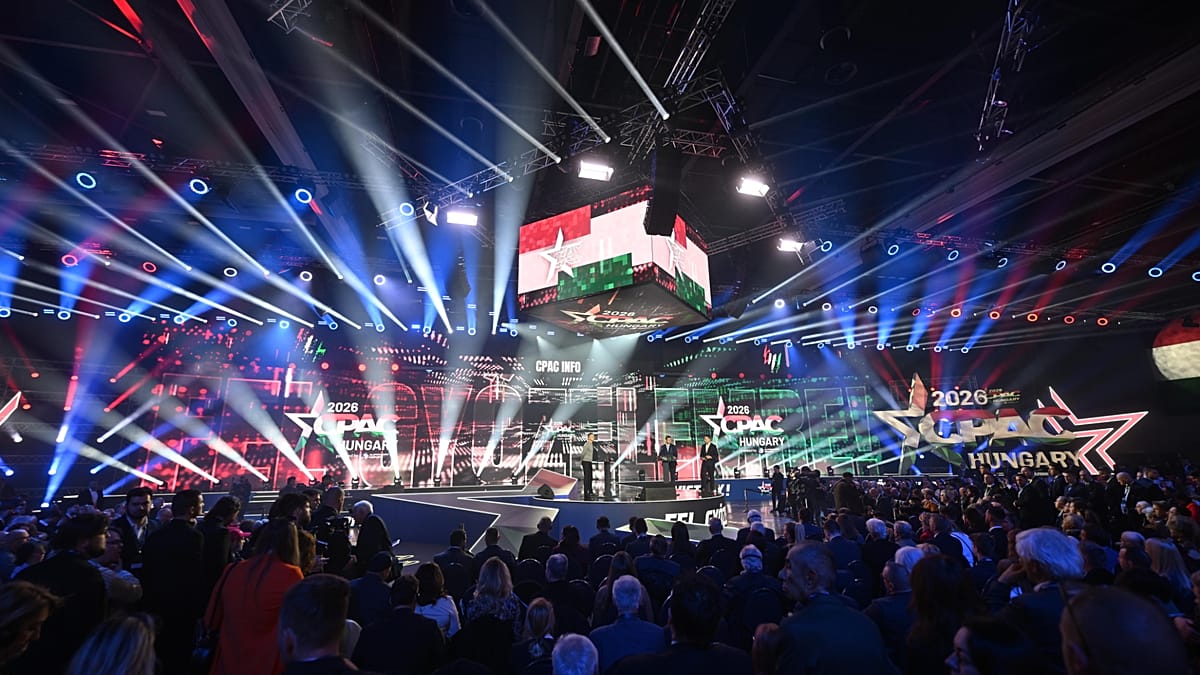
Key event: CPAC Hungary kicked off for the fifth time and US President Trump sent a video endorsing Viktor Orbán ahead of next month's general election. Major European far-right figures (Alice Weidel, Herbert Kickl, Geert Wilders) and Argentina's Javier Milei attended while Trump and VP JD Vance did not travel; Czech PM Andrej Babis missed the opening due to a suspected arson at a drone factory. Orbán framed a global right-wing realignment and tied the moment to geopolitical tensions (notably the US‑Israeli conflict with Iran) that he said are sending economic shockwaves.
This year's CPAC Hungary signal is less about ceremony and more about policy leverage: the short-term effect is higher political capacity for Budapest to obstruct EU-level green and conditionality measures. Mechanically that can delay or water down EU regulatory tightness (e.g., tighter emissions targets, renewable subsidy reallocations) — if Brussels stalls 6–18 months on incremental green mandates, EUA demand could fall by ~10–25% over that window as compliance and investment timelines slip. That directly benefits dispatchable generators and fossil-fuel incumbents in Europe while compressing near-term returns for large-scale renewables installers and project finance vehicles.
Geopolitically, the combination of US rhetorical endorsement and visible far‑right networking raises tail risks to Ukraine supply chains and to Central European security: targeted sabotage (e.g., weapons/drone factories) and permiting of pro‑Russia policy positions could intermittently disrupt defense procurement windows and force onshoring capital inflows into regional defense primes. These shocks trade on event horizons — days for tactical incidents, weeks-to-months for election outcomes and vetoes, and multi‑year if a durable right‑wing European bloc emerges to reshape EU rulemaking. Reversal triggers are equally discrete: an EU-level funding cutback, a strong opposition showing in Hungary’s election next month, or a US policy pivot that withdraws political cover.
Contrarian read: markets may be overstating an irreversible ‘‘autarky’’ shift. Brussels still controls cash flows and regulatory levers; a tactical Orbán win can delay but not fully replace pan‑EU energy transition economics. That argues for short-duration, event-driven positioning around the Hungarian election and upcoming EU Council/legislative timetables rather than long, unilateral bets that EU climate policy is permanently derailed.
AI-powered research, real-time alerts, and portfolio analytics for institutional investors.
Request DemoOverall Sentiment
neutral
Sentiment Score
0.00
